



Sugarcane Bagasse Packaging Is Quietly Dismantling a $300 Billion Industry Built on Plastic
The food service industry has a waste problem it spent decades pretending didn’t exist. Single-use plastic containers, Styrofoam clamshells, petroleum-derived takeout boxes — these weren’t incidental byproducts of a growing sector. They were the architecture. Cheap, scalable, and disposable by design. And for most of the 20th century, that architecture held. Then came the reckoning.
What’s replacing it isn’t just a greener material. It’s a fundamentally different philosophy of how disposable packaging should work — one where the end of a product’s life is accounted for at the beginning of its design. At the center of that philosophy sits sugarcane bagasse packaging: a fiber-based, compostable, heat-resistant material derived from the pulp left behind after sugarcane juice is extracted. Agricultural waste, repurposed into one of the most technically capable food-grade materials available on the market.
The irony is sharp. An industry built on extracting value and leaving waste behind is now being reformed by a material that is, itself, the waste of another industry.
What Bagasse Actually Is — And Why Most Buyers Misunderstand It
There’s a persistent misconception in procurement circles that bagasse products are a compromise — that choosing them means accepting weaker performance in exchange for environmental credibility. That view is outdated, and in many product categories, it’s simply wrong.
Sugarcane bagasse is the dry fibrous residue remaining after the stalk is crushed to extract juice. Historically, it was burned as fuel at sugar mills. What changed wasn’t the material — it was the engineering applied to it. Through pulping, pressing, and molding processes refined over the past two decades, bagasse has been transformed into containers, plates, bowls, and clamshells that can withstand temperatures exceeding 200°C, hold liquids without leaking, and decompose in commercial composting environments within 45–90 days.
Compare that to expanded polystyrene (EPS), which persists in landfills for an estimated 500 years and cannot be recycled in most municipal systems. The performance gap that once justified plastic’s dominance has narrowed considerably. In heat resistance, rigidity, and food safety compliance, bagasse food containers now match or exceed conventional alternatives in most food service applications.
Expert Insight: The most common purchasing mistake in sustainable packaging is conflating “eco-friendly” with “inferior performance.” Bagasse’s fiber structure gives it natural insulation properties that many petroleum-based products cannot replicate without additional chemical treatment.
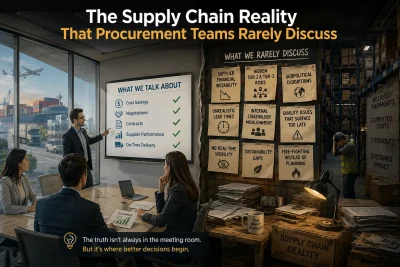
The Supply Chain Reality That Procurement Teams Rarely Discuss
Understanding bagasse as a material is one thing. Navigating it as a supply chain decision is another.
Raw bagasse is abundant — global sugarcane production exceeds 1.9 billion metric tons annually, generating enormous volumes of fibrous byproduct that mills must manage. But converting that raw material into food-grade packaging at commercial scale requires processing infrastructure, quality control systems, and regulatory compliance frameworks that vary significantly across suppliers and geographies.
This is where many businesses get into trouble. The sustainable packaging market has attracted a significant number of intermediaries — distributors who rebrand offshore product without transparent sourcing, certifications that don’t map to the markets where the packaging will be used, and price points that reflect quantity minimums far beyond what emerging brands or regional operators can absorb.
Partnering with established, vertically integrated suppliers who operate across material categories is one of the most effective ways to reduce that risk. Companies that handle both raw material sourcing and finished product distribution — across chemicals and metals alongside packaging substrates — bring cross-category procurement expertise that single-category distributors simply can’t match. That breadth of supply chain knowledge matters when compliance requirements, import regulations, or material substitutions need to be navigated quickly.
Silvari Group operates in precisely this space — providing industrial and commercial clients with material solutions that account for the full complexity of global supply chains, not just the catalogue page. Their work across diversified material sectors positions them to offer context that pure-play packaging vendors often lack.
A Direct Comparison: Bagasse vs. The Alternatives
The decision to transition to sustainable packaging rarely happens in isolation. It sits inside a larger conversation about cost, compliance, brand positioning, and operational feasibility. The table below compares sugarcane bagasse packaging against the three most common alternatives across the metrics that procurement and operations teams actually care about.
| Attribute | Sugarcane Bagasse | Polystyrene (EPS) | PLA (Bioplastic) | Virgin Plastic (PP/PE) |
|---|---|---|---|---|
| Heat Resistance | Up to 200°C | ~80°C | ~50–60°C | ~100–130°C |
| Compostability | 45–90 days (industrial) | Non-compostable | 90–180 days (industrial only) | Non-compostable |
| Moisture Resistance | High (with barrier coating) | High | Moderate | Very High |
| Carbon Footprint | Low (agricultural byproduct) | Very High | Moderate | Very High |
| Cost (relative) | Moderate | Low | High | Low |
| Regulatory Risk | Low (bans favor it) | Very High (widely banned) | Moderate | High (increasing bans) |
| Consumer Perception | Strongly positive | Strongly negative | Mixed | Negative |
The regulatory column deserves particular attention. Over 60 countries and dozens of municipalities have now enacted bans or restrictions on single-use plastics and EPS. Businesses that locked into plastic supply chains on cost grounds are now navigating expensive transitions under compliance pressure. Bagasse packaging was never the cheapest option — but it has proven to be one of the lowest-risk long-term bets in the category.
The E-E-A-T Problem With Sustainable Packaging Claims
One of the more uncomfortable truths in this sector is that not all “sustainable packaging” claims are created equal. The term has become so commercially useful that it now appears on products with vastly different environmental profiles — a phenomenon the industry calls greenwashing, and one that regulators in the EU, UK, and increasingly the United States are beginning to prosecute.
For buyers, this creates a verification burden. Certifications to look for in bagasse food containers include BPI (Biodegradable Products Institute) certification, TÜV Austria’s OK Compost mark, and EU food contact compliance under Regulation (EC) No 1935/2004. These aren’t marketing badges — they’re third-party attestations of specific performance thresholds. A supplier who cannot produce these on request is a supplier worth reconsidering.
The Silvari Group’s approach to client relationships reflects this accountability-first mindset — transparency in sourcing, clear documentation chains, and the kind of long-term partnership orientation that sustainable material procurement requires. For businesses serious about ESG reporting and supply chain traceability, that distinction between a transactional vendor and an integrated supply partner is not a minor one.
If your sourcing strategy for the coming year includes any shift toward compostable or reduced-plastic packaging, the most productive first step is a direct conversation with a team that understands both the material science and the commercial landscape. Reaching out to Silvari Group is a logical starting point for that conversation.
The Momentum Is Structural, Not Cyclical
What separates the current shift toward bagasse and compostable packaging from earlier “green” waves is its structural footing. It’s no longer driven by consumer sentiment alone — though that sentiment has hardened considerably. It’s driven by legislation, investor pressure on ESG metrics, retailer mandates filtering down to food service suppliers, and the simple mathematics of regulatory risk accumulating inside plastic-dependent supply chains.
The businesses positioned best for the next decade aren’t those who waited for the tipping point. They’re the ones who recognized, early, that sugarcane bagasse packaging wasn’t a niche product for sustainability-forward brands. It was the direction the entire industry was being pulled — whether operators chose to lead or be dragged.
The Economics of Switching: Why the “Bagasse Is Too Expensive” Argument Is Collapsing
For years, the cost objection dominated every procurement conversation about sustainable packaging. Finance teams would run the per-unit comparison, see the gap between bagasse and polystyrene, and close the folder. The math seemed straightforward. It wasn’t — because it was incomplete.
The per-unit price of a packaging material is the beginning of a cost analysis, not the end of one. What that figure excludes is the growing constellation of costs that plastic-dependent operations are now absorbing: regulatory compliance expenditure, waste management surcharges in jurisdictions with extended producer responsibility (EPR) legislation, brand remediation costs when sustainability failures become public, and the increasingly real cost of supply chain disruption as plastic bans force emergency pivots.
When those variables enter the calculation, the economics shift. Sugarcane bagasse packaging carries a higher unit cost in many categories — that remains true. But its total cost of ownership, evaluated across a three-to-five year operational horizon, is converging rapidly with conventional alternatives. In markets with active plastic taxes or EPR frameworks — the UK’s Plastic Packaging Tax, Italy’s plastics levy, Canada’s federal single-use plastics regulations — it has already crossed that threshold.
There’s a further dimension that pure cost analysis misses entirely: pricing power. Restaurants, catering companies, and food manufacturers that have transitioned to certified compostable packaging have documented measurable increases in customer willingness to pay. A 2023 Nielsen IQ study found that 69% of consumers in developed markets say sustainability credentials influence their food service choices. That’s not sentiment. That’s margin.
How Food Service Operators Are Actually Making the Transition
The transition from conventional packaging to bagasse food containers doesn’t happen in a single procurement cycle for most operations. It happens in stages, and understanding those stages is what separates a smooth migration from a chaotic one.
Stage 1 — Audit and Baseline
Before any purchasing decision, operators need a clear picture of their current packaging portfolio: SKU count, volume by category, supplier concentration, and existing certifications. This baseline matters because bagasse doesn’t replace every product class equally well. Hot food containers, plates, and bowls are natural fits. Cold beverage cups and high-moisture applications may require PLA-lined or wax-coated bagasse variants, or alternative substrates entirely.
Stage 2 — Supplier Qualification
This is where most transitions either gain traction or stall. Qualifying a bagasse supplier involves more than reviewing a product catalogue. It requires verifying third-party certifications, auditing minimum order quantities against operational demand, stress-testing lead times across peak and off-peak periods, and confirming food contact compliance in the specific regulatory jurisdictions where the product will be used.
Golden Rule: Never qualify a sustainable packaging supplier on samples alone. Request documented production batch testing data, ask for references from operators in your volume tier, and verify that certifications are current — not legacy credentials from a previous product line.
Stage 3 — Phased Rollout
Operators with complex menus or high-volume throughput benefit from category-by-category migration rather than wholesale replacement. Starting with the highest-visibility SKUs — the containers customers actually see and handle — maximizes the brand impact of the transition while limiting operational disruption.
Stage 4 — Communication and Verification
The final stage, consistently underestimated, is communicating the transition to customers and verifying that disposal infrastructure aligns with the material’s end-of-life requirements. Compostable packaging performs its environmental function only when it reaches appropriate composting facilities. Operators who fail to communicate this — or who introduce compostable packaging into waste streams without industrial composting access — undermine both the environmental outcome and the credibility of their sustainability claims.
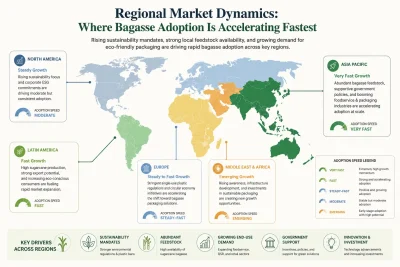
Regional Market Dynamics: Where Bagasse Adoption Is Accelerating Fastest
Adoption of sugarcane bagasse packaging is not uniform across geographies, and understanding the regional picture is essential for distributors, importers, and multinational food service operators making sourcing decisions.
Europe leads on regulatory pressure. The EU Single-Use Plastics Directive has fundamentally restructured the packaging landscape across member states, creating mandatory demand for compostable alternatives in food service categories. Germany, France, and the Netherlands have moved furthest in enforcement, but the directive’s reach is continent-wide.
North America presents a more fragmented picture. Federal-level action in Canada has outpaced the United States, where regulation remains largely state and municipal. California’s SB 54 — which mandates that all single-use plastic packaging be recyclable or compostable by 2032 — is the most consequential single piece of legislation in the sector, with supply chain implications that extend well beyond the state’s borders given California’s market scale.
Asia-Pacific is simultaneously the world’s largest producer of bagasse raw material and one of its most complex adoption markets. India, Thailand, and the Philippines have enacted single-use plastic restrictions that have accelerated domestic bagasse packaging industries. China’s 2021 plastic ban created significant demand shift, though enforcement consistency varies by province.
The Middle East and Africa represent the most significant emerging opportunity. Rising urbanization, expanding quick-service restaurant penetration, and growing regulatory attention to municipal waste management are creating structural demand for sustainable food service packaging in markets that have historically been underserved by global sustainable packaging supply chains.
The Certification Landscape: Cutting Through the Complexity
| Certification | Issuing Body | What It Confirms | Relevant Markets |
|---|---|---|---|
| BPI Certified Compostable | Biodegradable Products Institute | Industrial compostability per ASTM D6400 | North America |
| OK Compost Industrial | TÜV Austria | Industrial compostability per EN 13432 | Europe, global |
| OK Compost Home | TÜV Austria | Home compostability (stricter standard) | Europe |
| DIN CERTCO | DIN CERTCO | Compostability per EN 13432 | Europe |
| EU Food Contact | Per Reg. (EC) 1935/2004 | Food safety compliance | European Union |
| FDA Food Contact | U.S. Food & Drug Administration | Food safety compliance | United States |
A product carrying none of these marks but marketed as “eco-friendly” or “natural” is making a claim that merits scrutiny. The certification infrastructure exists precisely because the market cannot self-police on sustainability assertions. Buyers who anchor their supplier qualification process to this table will make fewer costly mistakes.
What the Next Five Years Actually Look Like
The forward trajectory of sustainable food packaging is not a straight line upward — it’s a compression event. Legislative timelines are converging. Consumer expectations are hardening faster than most brand teams anticipated. And the cost gap between bagasse and conventional packaging is narrowing on both sides simultaneously: bagasse production scale is improving unit economics while plastic taxation and EPR levies are increasing the effective cost of conventional alternatives.
By 2028, industry analysts project that compostable packaging will represent over 18% of the global food service packaging market by volume — up from approximately 7% in 2023. That’s not a niche share. That’s a structural category.
The operators, distributors, and procurement teams who treat this as a five-year migration will find themselves reasonably positioned. Those who treat it as a ten-year problem will find themselves in the same position that plastic-dependent businesses found themselves when regulatory timelines accelerated faster than their supply chains could adjust.
The window for orderly transition is open. It will not stay open indefinitely.
Frequently Asked Questions: Sugarcane Bagasse Packaging
The Questions Industry Professionals Are Actually Asking
Q1: Is sugarcane bagasse packaging genuinely compostable, or is that a marketing claim?
It depends entirely on the certification the product carries. Bagasse that has been certified by BPI (per ASTM D6400) or carries TÜV Austria’s OK Compost Industrial mark has been independently verified to break down within 180 days under industrial composting conditions — typically achieving full disintegration within 45–90 days. Uncertified products marketed as “natural” or “plant-based” without third-party verification may not meet these thresholds. Always request the certification documentation, not just the label.
Q2: Can bagasse containers be used in microwave and oven applications?
Yes, with important qualifications. Pure molded bagasse containers are generally microwave-safe and can withstand dry heat up to approximately 200°C. However, products with PLA linings or wax coatings — often added to improve moisture resistance — have lower heat thresholds, typically 50–60°C for PLA-lined variants. Always verify the specific product’s heat rating with your supplier before deploying in high-temperature food service applications.
Q3: How does bagasse packaging perform with wet or oily foods?
Uncoated bagasse has moderate resistance to moisture and oil. For applications involving soups, curries, or high-fat foods held for extended periods, barrier-coated bagasse — using water-based PFAS-free coatings — is the appropriate specification. The industry has largely moved away from PFAS (per- and polyfluoroalkyl substances) coatings following regulatory pressure, and reputable suppliers now offer compliant alternatives that maintain performance without the associated toxicology concerns.
Q4: What is the shelf life of bagasse packaging in storage?
Properly stored in a cool, dry environment away from direct sunlight and humidity, bagasse food containers have a shelf life of 18–24 months. Unlike some bioplastics, bagasse does not degrade significantly under normal warehouse conditions within this window. Exposure to sustained moisture or extreme heat during storage can accelerate fiber degradation and should be avoided.
Q5: Is sugarcane bagasse packaging food-safe?
Yes — when produced in compliance with applicable food contact regulations. In the United States, relevant products must comply with FDA food contact standards. In the European Union, compliance with Regulation (EC) No 1935/2004 is required. Certified bagasse packaging from established manufacturers routinely meets both frameworks. The critical variable is the coating and additive profile — ensure your supplier can confirm that no restricted substances are present in barrier coatings or bleaching agents used during production.
Q6: How does the carbon footprint of bagasse compare to recycled plastic?
Life cycle assessments consistently place sugarcane bagasse packaging favorably against both virgin and recycled plastic across most impact categories. The raw material is an agricultural byproduct — it would otherwise be burned or landfilled — meaning its embedded carbon is minimal. Recycled plastic still requires energy-intensive reprocessing and often involves downcycling rather than true closed-loop recycling. A 2022 LCA study published in the Journal of Cleaner Production found bagasse packaging generated approximately 60% lower greenhouse gas emissions per functional unit compared to equivalent EPS products.
Q7: Can bagasse packaging be home composted, or does it require industrial facilities?
Most commercially available bagasse packaging is certified for industrial composting only — temperatures in industrial facilities (55–60°C sustained) are required to achieve full biodegradation within the certified timeframe. Some specialist products carry OK Compost Home certification, indicating they will break down in ambient backyard composting conditions, though over a longer period. If your sustainability strategy depends on home compostability, verify this specifically at the point of purchase — the distinction matters both operationally and for ESG reporting accuracy.
Q8: What are the minimum order quantities typically associated with bagasse packaging procurement?
MOQs vary significantly by supplier tier and product category. Large-scale manufacturers typically require minimum orders of 10,000–50,000 units per SKU. Mid-tier distributors serving regional food service operators often work with MOQs of 1,000–5,000 units. For emerging brands or independent operators, consolidated purchasing through established distributors — rather than direct factory relationships — is usually the more practical and cost-effective route until volume justifies direct sourcing.
Q9: Does switching to bagasse packaging require changes to existing packaging machinery?
For pre-formed containers — clamshells, plates, bowls, and trays — no machinery changes are required on the food service operator’s side. These products function as direct drop-in replacements. For operations involved in packaging manufacturing or converting, bagasse’s fiber characteristics do interact differently with certain sealing and printing equipment. Consult with your equipment supplier and packaging partner before assuming full interoperability.
Q10: How should bagasse packaging be communicated to end consumers?
Effective consumer communication on compostable packaging requires specificity, not generality. “This container is certified compostable — please dispose of in food waste or composting collection” outperforms vague “eco-friendly” messaging in both consumer comprehension and behavioral compliance studies. Including a visible certification mark (BPI, OK Compost) alongside disposal instructions significantly improves correct end-of-life handling rates, which in turn validates the environmental benefit the packaging was selected to deliver.
Q11: Are there any foods or applications where bagasse packaging is not recommended?
Bagasse performs poorly in applications requiring extended cold storage below freezing — the fiber structure can become brittle under prolonged sub-zero exposure. It is also not suitable for carbonated beverage containment or applications requiring hermetic sealing without significant engineering modification. For dry goods, hot foods, and ambient or refrigerated prepared meals, sustainable food packaging made from bagasse is appropriate. For freezer-to-oven applications, verify the specific product’s rating with the manufacturer.
Q12: What role does PFAS play in bagasse packaging, and how do I know if my products are PFAS-free?
PFAS — per- and polyfluoroalkyl substances — were historically used as grease and moisture barriers in food packaging, including some bagasse products. They are now subject to regulatory restriction in the EU, several US states, and Canada due to their persistence in the environment and links to human health concerns. To verify PFAS-free status, request a supplier declaration confirming compliance with applicable restrictions (EU Regulation 2023/2006, California AB 1200, or equivalent) and ask for third-party testing data if the application is high-risk. Reputable manufacturers in the sugarcane bagasse packaging sector have largely completed this transition, but verification remains the buyer’s responsibility.
Q13: How do bagasse products handle printing and branding?
Bagasse accepts water-based, food-safe inks well and supports both direct printing and label application. The natural brown or bleached white surface of bagasse provides adequate contrast for most branding applications. Custom-molded shapes with embossed logos are also available from most major manufacturers at volume. Note that bleached white bagasse — while visually cleaner for branding — involves additional processing steps; some operators prefer the natural brown aesthetic as it communicates the product’s material origin transparently.
Q14: What certifications should I require from a bagasse packaging supplier as a baseline?
At minimum: BPI certification or OK Compost Industrial for compostability claims, plus FDA or EU food contact compliance documentation relevant to your market. If your operation has ESG reporting obligations, also request the supplier’s own environmental management certifications (ISO 14001 is the relevant standard) and any available product-level life cycle assessment data. A supplier unable to provide these on request within a reasonable timeframe is a procurement risk worth taking seriously.
Q15: Is sugarcane bagasse packaging scalable enough for enterprise-level food service operations?
Yes. Global production capacity for bagasse food containers has expanded substantially over the past decade, with major manufacturing infrastructure in China, India, Thailand, and Brazil. Enterprise-level food service operators — including major quick-service restaurant chains and airline catering companies — are already procuring bagasse packaging at scale. Lead time management and supplier diversification remain important considerations at volume, as with any agricultural-derived material, but capacity constraints that limited enterprise adoption five years ago have largely been resolved.
Authoritative External Resources
For readers seeking to deepen their research, the following sources provide independently verified data and regulatory guidance directly relevant to sustainable packaging procurement:
- Ellen MacArthur Foundation — The New Plastics Economy: ellenmacarthurfoundation.org — The definitive framework document for understanding global plastics transition economics and policy trajectory.
- Biodegradable Products Institute (BPI): bpiworld.org — North America’s primary certification body for compostable packaging; their certified products database is an essential procurement tool.
- TÜV Austria OK Compost Certification: tuv-austria.com — The European standard for industrial and home compostability verification, directly relevant to EU market compliance.
- European Commission — Single-Use Plastics Directive: environment.ec.europa.eu — Primary regulatory source for understanding EU packaging restrictions and their implementation timelines.
- U.S. FDA — Food Contact Substances: fda.gov — Authoritative reference for food safety compliance requirements applicable to packaging sold or used in the United States.