


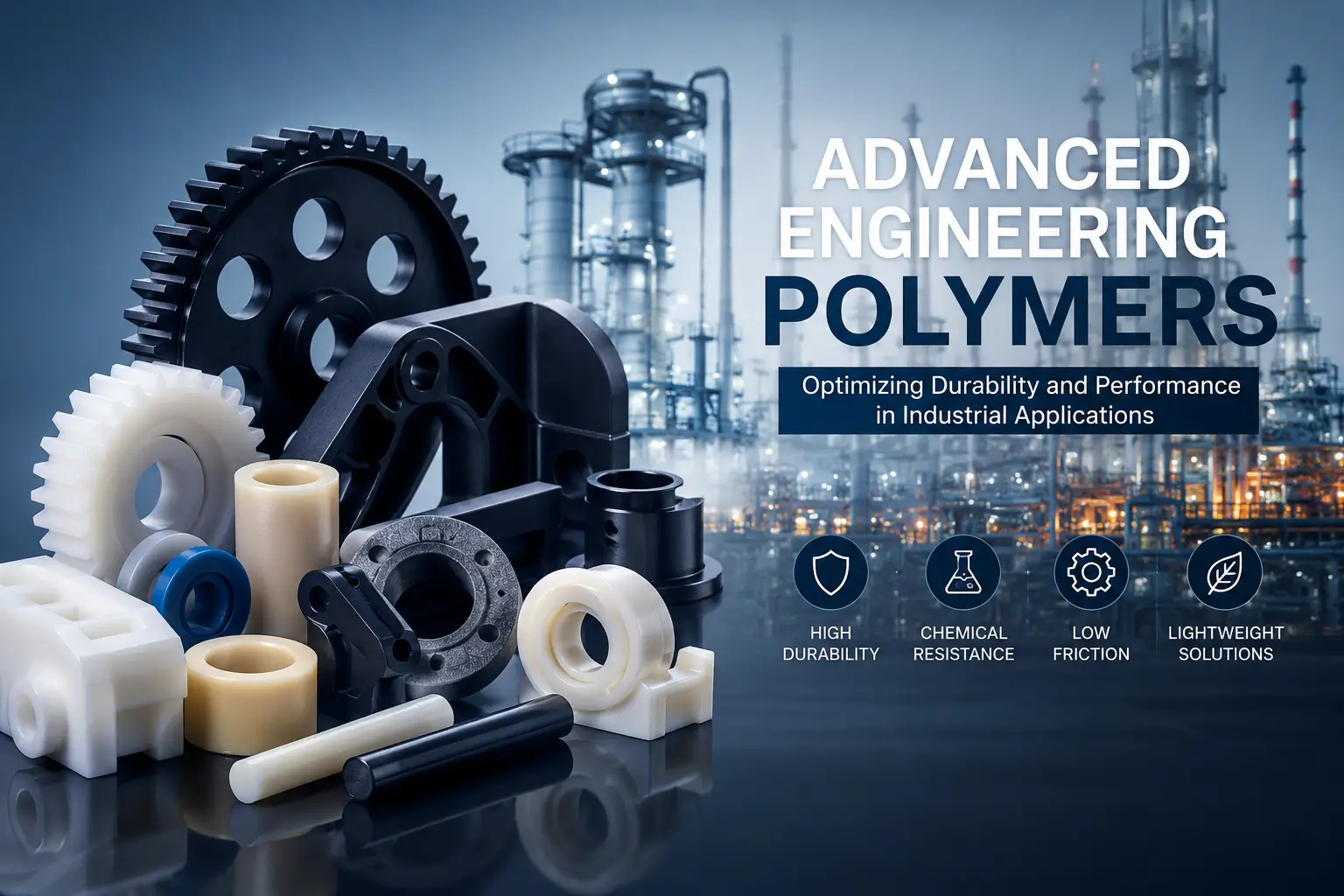
The Quiet Failure Behind Industrial Downtime: Why Conventional Materials Collapse Under Real Operating Loads
A production line rarely stops because of a dramatic mechanical catastrophe. More often, the shutdown begins with microscopic wear, thermal distortion, chemical swelling, or stress cracking inside a component nobody notices until tolerances drift beyond control. In heavy manufacturing, automotive systems, semiconductor production, and high-speed packaging environments, material failure behaves less like an accident and more like compound interest. Small degradation accumulates quietly, then strikes all at once.
This is where advanced engineering polymers have altered the economics of industrial design.
For decades, engineers relied on metals to solve every durability problem. Steel for strength. Aluminum for weight reduction. Bronze for wear resistance. Yet industrial operating conditions have evolved faster than traditional material assumptions. Machines now run hotter, faster, and with tighter tolerances. Chemical exposure has intensified. Energy efficiency targets have become aggressive. Corrosion resistance is no longer optional. Neither is dimensional stability.
Under these pressures, conventional materials reveal expensive weaknesses.
High-performance polymers, particularly engineered thermoplastics and specialty composite formulations, now occupy critical positions once dominated entirely by metal assemblies. Bearings, valve seats, electrical insulators, pump housings, sliding surfaces, structural supports, cable systems, and chemical-contact components increasingly depend on polymer science rather than brute-force metallurgy.
The shift is not cosmetic. It is operational.
Manufacturers adopting advanced polymer systems often report measurable reductions in lubrication dependency, maintenance intervals, system weight, and energy consumption. More importantly, they reduce one variable that destroys industrial profitability faster than almost anything else: unplanned downtime.
Organizations with deep exposure to industrial supply chains, such as Silvari Group, have witnessed how material selection decisions upstream directly affect reliability downstream. The gap between a stable production environment and a recurring maintenance nightmare frequently comes down to molecular structure rather than machine architecture.
Why Advanced Engineering Polymers Outperform Traditional Materials in Modern Industry
The conversation around polymers is often oversimplified. Many procurement teams still classify plastics as low-cost substitutes rather than engineered performance materials. That misconception leads to catastrophic specification errors.
Commodity plastics and advanced engineering polymers belong to entirely different categories.
A polyethylene container and a PEEK-based aerospace component may both technically be “plastic,” but comparing them is like comparing construction cement to semiconductor-grade silicon. Their chemistry, thermal behavior, mechanical resilience, and failure thresholds operate in completely different universes.
The Mechanical Advantage Hidden at the Molecular Level
Engineering polymers derive their performance from tightly controlled molecular architectures. Chain alignment, crystallinity, filler integration, and thermal stabilization create material behaviors tailored for precise industrial conditions.
The result is a class of materials capable of delivering:
- High tensile strength under cyclic loading
- Exceptional wear resistance
- Chemical inertness in aggressive environments
- Low friction coefficients
- Electrical insulation stability
- Reduced thermal conductivity
- Lightweight structural efficiency
In sectors where rotating equipment operates continuously, reducing friction alone can significantly lower system stress. Less friction means less heat generation. Less heat means slower degradation of seals, bearings, lubricants, and neighboring components.
That cascade effect matters financially.
A single polymer-based redesign inside a conveyor system or fluid transfer assembly can influence maintenance scheduling across the entire facility.
Thermal Stability Is No Longer a Premium Feature
Industrial temperatures continue rising because manufacturers demand faster throughput and tighter productivity metrics. Materials that performed adequately twenty years ago now fail prematurely under elevated thermal cycling.
This explains the growing adoption of polymers such as:
| Polymer Type | Key Industrial Strength | Typical Applications |
|---|---|---|
| PEEK | Extreme thermal resistance | Aerospace, semiconductor tooling |
| PTFE | Chemical resistance and low friction | Seals, gaskets, valve components |
| PPS | Dimensional stability at high heat | Electrical systems |
| UHMW-PE | Wear resistance | Conveyor systems |
| Polyimides | Long-term thermal endurance | Electronics and aerospace |
The strategic value here is not merely survival under heat. It is performance consistency.
Metals expand. Certain polymers can be engineered to maintain dimensional integrity with remarkable precision under fluctuating temperatures. In industries dependent on micron-level tolerances, that distinction changes production reliability entirely.
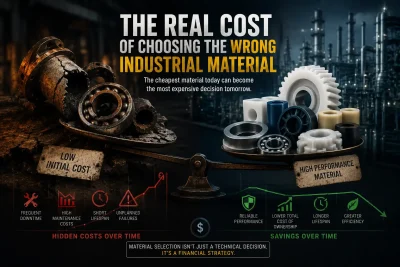
The Real Cost of Choosing the Wrong Industrial Material
Procurement departments often focus heavily on upfront material cost while underestimating lifecycle economics. This creates one of the most persistent operational inefficiencies in industrial manufacturing.
A lower-cost component that requires replacement every six months is not cheaper than a high-performance polymer assembly lasting five years under identical conditions.
Yet this mistake repeats constantly because many organizations evaluate materials through purchasing spreadsheets instead of operational data.
Downtime Economics Are Brutal
Consider a chemical processing facility where a failed seal halts production for four hours. The direct replacement cost may appear trivial. The indirect losses are not.
They include:
- Production interruption
- Labor inefficiency
- Product contamination risk
- Emergency maintenance premiums
- Energy waste during restart cycles
- Supply chain scheduling disruption
Now multiply that event across several facilities annually.
The financial damage escalates rapidly.
This is precisely why industrial suppliers with diversified material expertise, including access to both chemical systems and metal solutions like those presented through Silvari Group’s industrial materials portfolio and Silvari Group’s metals division, play a central role in modern manufacturing strategy. Effective material optimization rarely depends on one category alone. It depends on understanding where polymers outperform metals — and where hybrid solutions create better engineering outcomes.
Engineering Rule: The cheapest industrial material is usually the one that survives longest under actual operating conditions, not the one with the lowest invoice price.
Chemical Resistance: The Industrial Variable Most Companies Underestimate
Mechanical stress receives enormous attention during equipment design. Chemical exposure often receives far less.
That imbalance causes avoidable failures.
Acids, solvents, hydrocarbons, cleaning agents, humidity, and reactive compounds silently attack material structures over time. Corrosion in metals is visible. Chemical degradation in polymers is frequently invisible until catastrophic failure occurs.
Selecting the correct polymer requires understanding:
- Chemical compatibility
- Exposure duration
- Pressure conditions
- Temperature interaction
- Stress concentration zones
- Permeation behavior
A polymer that performs flawlessly in ambient laboratory conditions may fail rapidly inside a pressurized industrial reactor.
This is why experienced industrial material consultants matter. Companies with established engineering backgrounds and sector-specific sourcing expertise, such as Silvari Group’s technical advisory team, typically evaluate polymer suitability based on operating realities rather than theoretical specification sheets alone.
That distinction separates durable engineering from expensive experimentation.
Weight Reduction Is Reshaping Industrial Equipment Design
Industrial systems are becoming lighter for one reason: efficiency compounds.
Reducing component weight decreases:
- Energy consumption
- Motor strain
- Vibration load
- Transportation costs
- Structural stress
- Installation complexity
In robotics and automated manufacturing environments, even modest reductions in moving mass can dramatically improve cycle speed and positional accuracy.
Advanced polymers allow engineers to redesign assemblies without inheriting the corrosion vulnerabilities or density penalties associated with many metal systems.
This becomes particularly valuable in industries balancing mechanical performance against energy efficiency regulations.
The irony is difficult to ignore. For decades, industrial engineering equated heaviness with durability. Yet some of the most resilient modern systems achieve their reliability precisely because they eliminate unnecessary mass.
Where Industrial Buyers Still Make Critical Mistakes
One of the most damaging procurement habits involves specifying materials based solely on legacy familiarity.
Engineers inherit old designs.
Suppliers repeat old recommendations.
Procurement teams reuse historical specifications.
Nobody revisits whether the material still represents the best solution.
Meanwhile, operational conditions evolve continuously.
Temperature profiles change.
Chemical exposure intensifies.
Production speeds increase.
Regulatory pressures tighten.
Material strategy that worked ten years ago may now be quietly draining profitability.
The manufacturers gaining competitive advantage are not necessarily using revolutionary machinery. Many are simply making smarter material decisions earlier in the engineering process — then building procurement partnerships capable of adapting as operational demands shift.
For organizations evaluating industrial material optimization strategies or sourcing partnerships, direct consultation channels with Silvari Group specialists increasingly become part of broader reliability planning rather than isolated purchasing conversations.
Wear Resistance and Friction Control: The Battlefield Where Engineering Polymers Quietly Defeat Metals
Industrial wear rarely announces itself immediately. It begins invisibly — microscopic abrasion, surface scoring, particulate contamination, gradual deformation under repetitive load cycles. Then one day, vibration increases. Energy consumption spikes. Alignment drifts. Bearings fail. Production managers call maintenance teams at 2:00 AM.
In many facilities, these failures are accepted as routine operational reality. They should not be.
A substantial percentage of industrial wear problems originate not from poor machine design, but from inappropriate material interaction under dynamic conditions. Metal-on-metal contact, especially in high-speed systems, creates a destructive ecosystem of friction, heat generation, lubrication dependency, and surface fatigue.
This is one of the areas where advanced engineering polymers fundamentally changed industrial reliability models.
The Friction Equation Most Facilities Underestimate
Traditional mechanical systems were engineered around the assumption that friction must be managed continuously through lubrication. The logic made sense when metals dominated every rotating assembly.
But lubrication introduces secondary problems:
- Contamination risk
- Maintenance dependency
- Temperature sensitivity
- Leakage exposure
- Chemical instability
- Downtime during servicing
Certain high-performance polymers eliminate portions of that equation entirely.
Materials such as PTFE-filled compounds, UHMW-PE, nylon composites, and acetal-based engineering polymers exhibit naturally low friction coefficients. In many applications, they allow dry-running or near-dry-running operation without the aggressive wear patterns associated with metallic contact surfaces.
The operational implications are enormous.
Conveyor systems run cleaner.
Food-processing environments reduce contamination exposure.
Packaging systems maintain smoother motion profiles.
Automated production lines experience fewer stoppages caused by lubrication failure.
The benefit extends beyond maintenance reduction. Lower friction directly influences energy efficiency. Motors consume less power overcoming resistance. Heat generation declines. Component stress decreases across adjacent assemblies.
The machine does not merely last longer. It behaves more predictably.
Why Polymer Bearings Are Expanding Across Multiple Industries
Metal bearings remain essential in extreme-load environments, but polymer bearing systems now dominate many applications where corrosion, contamination, or lubrication complexity once created chronic operational problems.
Industries aggressively adopting polymer bearing technologies include:
- Food and beverage processing
- Pharmaceutical manufacturing
- Marine engineering
- Semiconductor fabrication
- Agricultural automation
- Water treatment systems
The reason is straightforward.
A corroded metallic bearing gradually destroys precision. A chemically resistant polymer bearing can maintain operational stability even under moisture exposure, washdown cycles, or chemically aggressive cleaning procedures.
In food production environments especially, lubricant migration creates both operational and regulatory exposure. Polymer systems reduce that vulnerability dramatically.
Golden Rule for Industrial Reliability: Every unnecessary lubrication point eventually becomes a maintenance liability.
The Hidden Relationship Between Advanced Engineering Polymers and Energy Efficiency
Energy efficiency discussions inside industrial sectors often focus on motors, drives, HVAC systems, or automation software. Material science receives far less attention despite its direct impact on energy consumption.
That oversight is becoming increasingly expensive.
Weight reduction, friction reduction, and thermal management all influence how much energy industrial systems consume during operation. Advanced polymers affect all three simultaneously.
Lighter Components Change System Dynamics
Replacing metal components with engineered polymers does more than reduce static weight. It changes inertia profiles across moving systems.
Lower rotational mass allows:
- Faster acceleration
- Reduced motor strain
- Lower startup energy demand
- Smoother dynamic response
- Reduced vibration transmission
In robotics and automated handling systems, these improvements directly affect throughput efficiency.
The effect becomes especially pronounced in facilities operating thousands of repetitive motion cycles per hour. Small efficiency gains multiplied continuously across production environments generate substantial long-term savings.
This is partly why automotive manufacturers aggressively expanded polymer integration throughout vehicle systems. Reduced weight improves fuel efficiency, battery range, and emissions performance simultaneously.
Industrial manufacturing is following the same trajectory.
Thermal Insulation Creates Secondary Efficiency Gains
Metals transfer heat aggressively. In some environments, that characteristic becomes operationally destructive.
Engineering polymers frequently provide controlled thermal insulation properties that stabilize surrounding systems. This matters in:
- Electrical enclosures
- Semiconductor equipment
- High-voltage systems
- Precision instrumentation
- Chemical processing units
Reducing unwanted heat transfer helps maintain operational consistency while protecting adjacent components from thermal stress accumulation.
The outcome is not merely component protection. It is process stability.
And stable processes produce fewer defects.
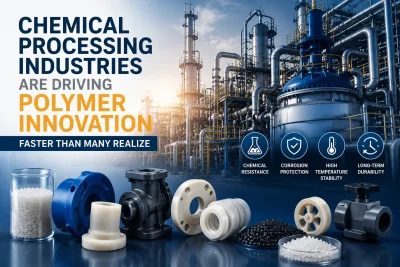
Chemical Processing Industries Are Driving Polymer Innovation Faster Than Many Realize
Few industrial sectors punish material failure more aggressively than chemical processing.
A minor material compatibility error inside a fluid handling system can produce:
- Seal failure
- Chemical leakage
- Environmental exposure
- Production contamination
- Regulatory violations
- Catastrophic shutdowns
This reality forced rapid advancement in polymer engineering over the last two decades.
Why Metals Fail Quietly in Corrosive Systems
Many metals deteriorate progressively when exposed to aggressive chemicals. Corrosion weakens surfaces, compromises tolerances, and introduces particulate contamination into processing environments.
The danger lies in the gradual nature of the degradation.
Operators may not detect the problem until:
- Flow rates change
- Pressure irregularities emerge
- Surface integrity collapses
- Contamination affects product quality
Engineering polymers resistant to acids, solvents, hydrocarbons, and reactive compounds significantly reduce those risks when selected correctly.
However, polymer selection is not interchangeable.
PTFE may excel in one environment while failing under mechanical load elsewhere. PEEK may withstand heat but prove economically excessive for simpler chemical exposure applications. Nylon variants may absorb moisture under certain humidity conditions, affecting dimensional accuracy.
Material science becomes highly application-specific at this level.
That complexity explains why experienced industrial sourcing and technical evaluation matter more than generalized catalog specifications.
Electrical and Electronics Industries Depend Increasingly on Polymer Precision
One of the least publicly discussed transformations in industrial manufacturing involves the expansion of polymers across electrical and electronic systems.
Miniaturization changed everything.
As electronic assemblies became denser and more thermally sensitive, traditional materials created increasing engineering limitations.
Electrical Stability Under Harsh Conditions
Advanced engineering polymers now play essential roles in:
- Connectors
- Cable insulation systems
- Circuit protection assemblies
- Semiconductor manufacturing tools
- Sensor housings
- High-voltage insulating structures
The primary advantage is controlled electrical behavior combined with dimensional stability.
Many engineered polymers maintain:
- Dielectric strength
- Arc resistance
- Flame retardancy
- Thermal endurance
- Moisture resistance
under operating conditions where conventional materials deteriorate or introduce reliability risks.
This is particularly critical in industries dependent on uninterrupted uptime. Semiconductor fabrication plants, for example, can lose enormous production value from microscopic contamination or environmental instability.
A poorly selected material inside one subsystem can compromise an entire manufacturing batch worth millions.
Sustainability Pressures Are Quietly Accelerating Polymer Adoption
Public sustainability discussions often focus on consumer packaging, recycling campaigns, or renewable energy headlines. Industrial sustainability operates differently.
Inside manufacturing environments, sustainability is increasingly measured through:
- Operational longevity
- Energy consumption reduction
- Maintenance minimization
- Waste reduction
- Lifecycle optimization
This perspective changes how advanced polymers are evaluated.
A high-performance polymer component lasting six times longer than a metallic alternative may reduce total environmental impact despite higher initial production complexity.
The sustainability equation becomes operational rather than symbolic.
Durability Is an Environmental Strategy
Industrial waste frequently originates from premature component replacement.
Every failed part generates:
- Manufacturing demand for replacements
- Transportation emissions
- Packaging waste
- Disposal requirements
- Downtime-related energy inefficiency
Long-life polymer systems reduce that cycle substantially.
This explains why many industrial sectors now integrate lifecycle analysis directly into material procurement strategies rather than focusing exclusively on upfront acquisition cost.
The broader shift is philosophical as much as technical.
Manufacturers increasingly recognize that durability itself is an environmental metric.
The Supply Chain Reality Reshaping Industrial Material Decisions
Recent global supply disruptions exposed a dangerous weakness across industrial manufacturing: overdependence on rigid material sourcing models.
Facilities relying on narrowly specified legacy materials often experienced:
- Procurement delays
- Maintenance bottlenecks
- Production interruptions
- Escalating replacement costs
Engineering polymers introduced new flexibility into supply-chain resilience planning.
Equivalent-performance alternatives can sometimes be sourced more efficiently than specialized metallic systems, particularly when manufacturers build diversified supplier relationships capable of adapting quickly to market disruptions.
The industrial organizations maintaining operational continuity during volatile supply conditions were rarely the ones using the cheapest materials. They were the ones using the smartest sourcing strategies combined with adaptive engineering design.
And increasingly, those strategies revolve around advanced material science rather than traditional procurement habits.
Why Aerospace and Automotive Engineers Treat Material Selection Like Risk Management
In high-performance industries, materials are not passive components. They are active variables inside safety calculations, fuel efficiency models, thermal management systems, and operational lifespan projections.
Aerospace engineers understood this long before most industrial sectors caught up.
Aircraft environments expose materials to:
- Extreme thermal cycling
- Pressure fluctuations
- Vibration fatigue
- Chemical exposure
- UV degradation
- Mechanical stress concentration
Traditional metals remain indispensable in structural airframe applications, yet advanced engineering polymers increasingly dominate secondary and semi-structural systems because they solve a problem metals cannot solve efficiently: achieving durability without excessive mass.
That balance changed modern engineering priorities permanently.
Weight Is Not Just About Fuel Consumption
Reducing weight inside aerospace or automotive systems creates cascading performance advantages.
Lower weight influences:
- Fuel efficiency
- Battery range
- Thermal management
- Braking performance
- Mechanical stress distribution
- Payload optimization
A few kilograms removed from a dynamic system can alter long-term operational economics dramatically.
This is why polymers now appear inside:
- Under-the-hood automotive assemblies
- Electrical insulation systems
- Fuel system components
- Aerospace cabin structures
- Fluid handling systems
- Structural reinforcement composites
The transition accelerated because modern engineered polymers no longer behave like fragile substitutes. Many deliver exceptional fatigue resistance while maintaining structural consistency under highly variable environmental conditions.
Heat Resistance Became a Defining Engineering Priority
Modern engines operate under temperatures that would have severely compromised older polymer generations.
The evolution of materials such as:
- PEEK
- PPS
- Polyetherimide
- Fluoropolymers
- High-temperature nylons
allowed engineers to place polymer systems directly into demanding thermal environments previously reserved for metals.
That development reduced system complexity while improving corrosion resistance and lowering overall assembly weight.
The irony is difficult to miss: industries once obsessed with metal strength now aggressively pursue non-metallic alternatives to improve reliability.
Advanced Engineering Polymers in Semiconductor Manufacturing: Precision at the Microscopic Level
Few industries impose stricter material requirements than semiconductor manufacturing.
Inside fabrication facilities, microscopic contamination can destroy entire production batches worth enormous sums. Materials must perform under conditions where:
- Electrostatic behavior matters
- Chemical purity matters
- Outgassing matters
- Thermal stability matters
- Surface integrity matters
At this level, even molecular instability becomes operationally dangerous.
Why Semiconductor Facilities Depend on Specialized Polymers
Advanced polymers used in semiconductor production equipment often require:
- Ultra-low particle generation
- Exceptional chemical resistance
- Controlled dielectric properties
- Precision dimensional stability
- Resistance to plasma exposure
Materials failing in these environments do not merely wear out. They contaminate processes.
This explains the rise of highly engineered polymer compounds tailored specifically for semiconductor manufacturing systems.
Applications include:
- Wafer handling components
- Chemical transport systems
- Pump assemblies
- Insulation structures
- Precision machining fixtures
- Cleanroom-compatible equipment
The challenge is not only durability. It is predictability under extreme operational sensitivity.
A component lasting longer while generating fewer particles can significantly improve production yield consistency.
That single improvement may influence millions in annual manufacturing value.
The Maintenance Revolution Nobody Talks About
Industrial innovation conversations usually revolve around automation, artificial intelligence, robotics, or smart factories. Yet one of the most financially impactful transformations happening quietly across manufacturing involves maintenance reduction through material optimization.
This is less glamorous than automation headlines. It is also extraordinarily profitable.
Maintenance Is One of Industry’s Largest Invisible Expenses
Maintenance costs rarely appear dramatic in isolation.
A seal replacement here.
A bearing issue there.
A conveyor adjustment somewhere else.
But across large-scale industrial operations, maintenance inefficiency compounds relentlessly.
The real expense includes:
- Labor allocation
- Downtime exposure
- Spare parts inventory
- Emergency response logistics
- Production instability
- Equipment lifespan reduction
Advanced engineering polymers reduce maintenance burden because many are inherently resistant to:
- Corrosion
- Surface wear
- Lubrication dependency
- Chemical attack
- Moisture degradation
The cumulative effect matters more than any individual component improvement.
A facility experiencing fewer interruptions operates differently psychologically as well. Maintenance shifts from reactive crisis management toward controlled operational planning.
That transition changes productivity culture across the organization.
Operational Insight: The best industrial maintenance event is the one that never becomes necessary.
Why Material Compatibility Failures Continue Despite Better Technology
The industrial world has access to better materials than at any point in manufacturing history. Yet compatibility failures still happen constantly.
Why?
Because many organizations continue selecting materials through fragmented decision-making processes.
Engineering teams prioritize mechanical performance.
Procurement departments prioritize cost.
Operations teams prioritize availability.
Maintenance teams prioritize replacement simplicity.
Those priorities frequently conflict.
The Specification Gap Creates Expensive Mistakes
A polymer performing perfectly in laboratory conditions may fail rapidly under real operating loads because actual industrial conditions rarely behave exactly like theoretical models.
Unexpected variables include:
- Continuous vibration
- Mixed chemical exposure
- Abrasive contamination
- Thermal shock cycles
- UV degradation
- Humidity fluctuation
- Pressure instability
Even minor specification oversights can create severe operational consequences.
For example:
- A polymer with excellent chemical resistance may creep excessively under sustained load.
- A high-strength material may become brittle under low-temperature cycling.
- A dimensionally stable compound may degrade under UV exposure.
This is why experienced industrial engineering consultation remains critically important despite advances in simulation software and material databases.
Real-world operating knowledge still matters.
Composite Engineering Is Redefining Industrial Material Science
One of the most important developments inside advanced engineering polymers involves composite integration.
Modern industrial polymers increasingly combine:
- Carbon fiber
- Glass fiber
- Ceramic fillers
- Graphite additives
- Lubricating compounds
- Mineral reinforcements
These combinations create materials with highly specialized performance profiles impossible through traditional polymers alone.
Composite Systems Solve Contradictory Engineering Demands
Industrial systems often require properties that naturally conflict:
- High strength with low weight
- Rigidity with vibration damping
- Thermal resistance with electrical insulation
- Wear resistance with low friction
Composite polymer engineering allows manufacturers to balance these contradictions with remarkable precision.
Carbon-filled PEEK, for example, may deliver enhanced stiffness and thermal performance. Glass-filled nylons improve structural strength while maintaining corrosion resistance. PTFE-filled compounds reduce friction dramatically in dynamic assemblies.
The future of industrial material science increasingly revolves around customization rather than universal material categories.
Instead of asking:
“What is the strongest material?”
Engineers increasingly ask:
“What is the most optimized material for this exact operational environment?”
That is a fundamentally different philosophy.
Digital Manufacturing and Advanced Polymers Are Converging Rapidly
Additive manufacturing accelerated interest in engineering polymers beyond prototyping applications.
Industrial 3D printing systems now process advanced thermoplastics capable of producing:
- Functional components
- Custom tooling
- Lightweight structural parts
- Chemical-resistant assemblies
- Rapid replacement components
This changes manufacturing flexibility dramatically.
Rapid Iteration Reduces Engineering Risk
Traditional manufacturing often forced companies into expensive tooling commitments before validating long-term component performance.
Advanced polymer printing technologies allow:
- Faster design iteration
- Lower prototyping costs
- Reduced lead times
- On-demand part production
- Localized manufacturing flexibility
The implications for industrial maintenance alone are substantial.
Instead of waiting weeks for specialized replacement parts, facilities may increasingly produce validated polymer components internally or through regional manufacturing partners.
That flexibility improves resilience while reducing inventory dependency.
The Future of Industrial Performance Is Material Intelligence
The next competitive divide in industrial manufacturing will not belong exclusively to companies with larger factories or cheaper labor.
It will increasingly belong to organizations capable of making smarter engineering decisions at the material level.
Advanced engineering polymers sit directly at the center of that shift.
They influence:
- Energy efficiency
- Operational uptime
- Product consistency
- Maintenance economics
- Sustainability targets
- Supply chain resilience
- System lifespan
The companies treating material selection as a strategic discipline rather than a procurement formality are already operating differently from competitors trapped in outdated engineering assumptions.
And that gap is widening.
Frequently Asked Questions About Advanced Engineering Polymers in Industrial Applications
1. What are advanced engineering polymers?
Advanced engineering polymers are high-performance synthetic materials specifically engineered to withstand demanding industrial environments involving heat, pressure, friction, chemicals, and mechanical stress. Unlike commodity plastics, these materials are designed for structural reliability, dimensional stability, and long-term operational durability.
Common examples include:
- PEEK
- PTFE
- PPS
- Polyimides
- UHMW-PE
- Acetal compounds
They are widely used in aerospace, automotive manufacturing, semiconductor production, automation systems, chemical processing, and electrical engineering.
2. Why are engineering polymers replacing metals in many industries?
Engineering polymers solve several operational problems traditional metals struggle with, including:
- Corrosion resistance
- Weight reduction
- Friction control
- Chemical stability
- Electrical insulation
- Lower maintenance requirements
In many systems, replacing metallic components with advanced polymers improves efficiency while reducing wear, energy consumption, and lubrication dependency.
The objective is not eliminating metals entirely. The objective is optimizing performance through intelligent material selection.
3. Are advanced engineering polymers strong enough for heavy industrial applications?
Yes — when properly selected.
Many high-performance polymers exhibit exceptional:
- Tensile strength
- Fatigue resistance
- Wear resistance
- Thermal endurance
Some reinforced polymer composites rival or outperform metals in specific applications, especially where lightweight strength and chemical resistance are critical.
However, material selection must always match:
- load conditions,
- operating temperature,
- environmental exposure,
- and mechanical stress profiles.
4. Which industries rely most heavily on advanced engineering polymers?
The strongest adoption currently exists in:
- Aerospace
- Automotive manufacturing
- Semiconductor fabrication
- Medical equipment
- Chemical processing
- Robotics and automation
- Food and beverage production
- Marine engineering
- Energy infrastructure
These industries demand materials capable of maintaining performance under aggressive operational conditions.
5. How do engineering polymers reduce maintenance costs?
Advanced polymers reduce maintenance through:
- Lower friction
- Corrosion resistance
- Reduced lubrication requirements
- Improved wear resistance
- Longer operational lifespan
In many industrial systems, maintenance costs originate from repetitive component degradation. Engineering polymers extend service intervals and reduce unplanned downtime, which significantly improves lifecycle economics.
6. What is the difference between commodity plastics and engineering polymers?
Commodity plastics are primarily designed for low-cost, general-purpose applications such as packaging or consumer goods.
Engineering polymers are designed for:
- Mechanical performance
- Thermal resistance
- Structural stability
- Precision manufacturing
- Industrial durability
The performance gap between the two categories is enormous.
Treating them as interchangeable is one of the most common industrial procurement mistakes.
7. Can engineering polymers handle high temperatures?
Many can.
High-performance materials such as PEEK, PPS, and polyimides are specifically engineered for elevated thermal environments. Certain formulations maintain dimensional and mechanical stability under temperatures exceeding several hundred degrees Celsius.
Thermal capability depends entirely on the polymer family and additive structure.