


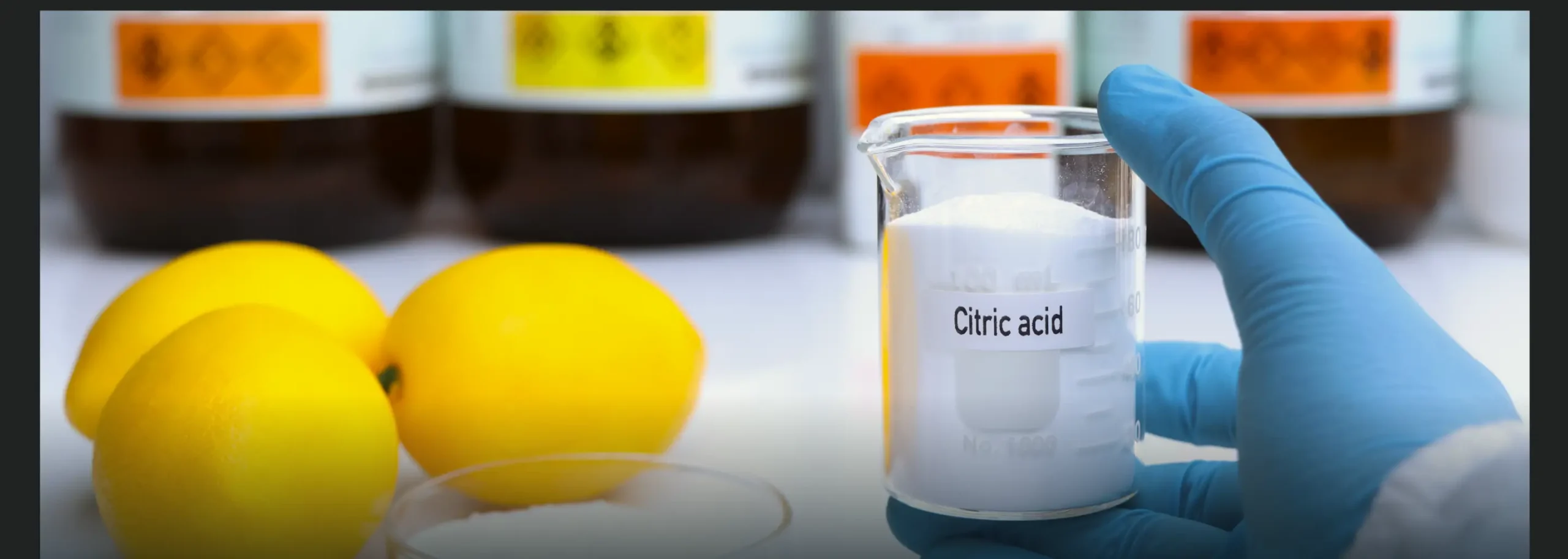
Citric Acid

Table of Contents
ToggleApplications

Food & Beverage: used as an acidity regulator, flavor enhancer, and preservative in drinks, confectionery, and processed foods

Pharmaceutical: functions as a pH adjuster, effervescent agent, and stabilizer in formulations.
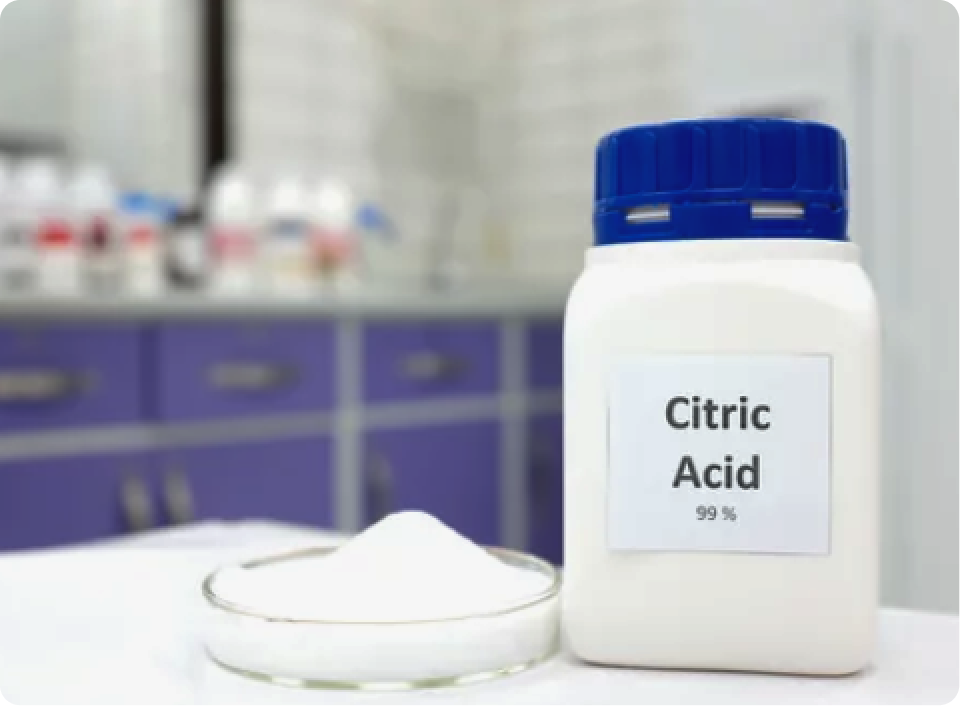
Industrial & Technical: applied in detergents, metal cleaning, water treatment, and cosmetics for its chelating and buffering properties.
Forms & Grades
Citric Acid Anhydrous
Solid crystalline form, ideal where moisture sensitivity is required.
Available Grades:
- Food / FCC
- USP / EP / BP
- Industrial
Citric Acid Monohydrate
Solid crystalline form with one molecule of water, widely used in food, pharma, and industrial applications.
Available Grades:
- Food / FCC • USP / EP / BP • Industrial
Liquid Citric Acid
Pre-dissolved in water, suited for process industries and cleaning formulations.
Available Grades:
- Food / FCC • Industrial
Technical Identification
- CAS Number: 77-92-9
- EC Number: 201-069-1
Regulatory Status
- Food-grade: compliant with EU food regulations and FDA requirements
- Industrial-grade: aligned with international chemical regulations such as REACH
Industrial Citric Acid Supplier in Europe | EU Compliant Bulk Supply Solutions
Selecting an Industrial Citric Acid supplier Germany is not simply about finding the lowest price. For manufacturers across Europe, the right supplier must consistently deliver EU-compliant citric acid, verified quality documentation, reliable bulk logistics, and stable product availability. Whether you operate in food production, pharmaceuticals, industrial cleaning, or chemical manufacturing, choosing a supplier with transparent certifications and dependable supply capabilities reduces production risks and ensures long-term operational efficiency.
This guide explains how to evaluate industrial citric acid suppliers in Europe, the differences between monohydrate and anhydrous grades, essential EU compliance requirements, and the industries that rely on high-purity citric acid. By the end, you will understand what distinguishes a trusted bulk supplier and which technical factors should influence your purchasing decisions.
Understanding Industrial Citric Acid Properties and Uses
Industrial citric acid is one of the world’s most versatile organic acids, widely used because of its excellent chelating ability, buffering capacity, acidity regulation, and environmentally friendly characteristics. Produced primarily through controlled fermentation, industrial citric acid offers consistent purity levels suitable for a broad range of manufacturing sectors.
For companies searching for an Industrial Citric Acid supplier Germany, product consistency is often more important than price alone. Variations in purity, moisture content, particle size, or packaging quality can directly affect production efficiency, product stability, and regulatory compliance.
Citric acid functions as:
- A pH regulator
- A chelating agent for metal ions
- A preservative enhancer
- An antioxidant synergist
- A cleaning and descaling ingredient
- A formulation stabilizer
These properties make it suitable for industries requiring predictable chemical performance and repeatable production results.
European manufacturers also value citric acid because it is biodegradable and aligns with modern sustainability objectives. Compared with harsher mineral acids, citric acid provides effective cleaning and processing performance while reducing environmental impact in many industrial applications.
A professional Citric Acid Supplier Europe should therefore provide not only high-quality material but also complete technical documentation, consistent batch quality, and supply chain transparency that supports industrial production throughout Europe.
What Is Industrial Citric Acid Used For?
Industrial citric acid serves a wide variety of sectors because it combines excellent chemical performance with a strong safety profile. Rather than serving a single market, it has become an essential raw material across numerous manufacturing processes.
In food processing, citric acid regulates acidity, improves flavor stability, extends shelf life, and supports beverage formulation. Beverage manufacturers rely on consistent acidity levels to maintain identical taste profiles across production batches.
Within pharmaceutical manufacturing, citric acid is incorporated into tablets, syrups, effervescent products, and buffered formulations. High purity is essential because pharmaceutical applications require strict compliance with European quality standards.
Industrial cleaning manufacturers use citric acid as an environmentally responsible descaling agent capable of removing calcium deposits, rust residues, and mineral buildup from processing equipment. This makes it particularly valuable for food factories, water treatment systems, and industrial maintenance operations.
Chemical manufacturers also utilize citric acid as a complexing agent that improves formulation stability while controlling metal ion reactions in specialized production environments.
Companies evaluating an Industrial Citric Acid supplier Germany typically consider whether the supplier can support multiple application sectors simultaneously. A supplier capable of serving food, pharmaceutical, cosmetic, and industrial markets demonstrates stronger quality management systems and broader technical expertise.
Because manufacturing requirements continue to evolve, buyers increasingly seek suppliers offering flexible packaging options, reliable inventory management, and technical support alongside competitive pricing.
Main Types of Industrial Citric Acid Products
Industrial citric acid is primarily available in two commercial forms: Citric Acid Monohydrate and Citric Acid Anhydrous. Although both share the same fundamental chemical properties, they differ in moisture content, physical characteristics, and preferred industrial applications.
Selecting the appropriate product depends on processing conditions, storage environment, formulation requirements, and desired product performance.
Product Type | Water Content | Typical Applications | Main Advantage |
Citric Acid Monohydrate | Contains one molecule of crystal water | Food processing, beverages, pharmaceuticals | Excellent stability and broad applicability |
Citric Acid Anhydrous | Water-free crystalline form | Dry blends, powders, moisture-sensitive formulations | Lower moisture and improved dry processing performance |
A reliable Bulk Citric Acid Supplier should help customers determine which grade best matches their manufacturing process rather than offering a one-size-fits-all recommendation. Technical consultation can reduce formulation issues and improve production efficiency.
Citric Acid Monohydrate Specifications
Citric Acid Monohydrate is the most widely used grade throughout Europe because of its excellent stability and compatibility with numerous manufacturing processes. It crystallizes with one molecule of water, giving it physical properties that make handling and storage straightforward under normal industrial conditions.
Manufacturers in the food, beverage, and pharmaceutical industries frequently select this grade because it dissolves readily in water while maintaining consistent chemical performance.
Typical specifications include:
- High purity suitable for industrial and food applications
- White crystalline appearance
- Excellent water solubility
- Controlled particle size distribution
- Low impurity profile
- Reliable batch-to-batch consistency
When sourcing from an Industrial Citric Acid supplier Germany, buyers should verify that product specifications remain consistent across every shipment. Even minor variations can influence mixing behavior, production efficiency, and final product quality.
Professional suppliers also provide Certificates of Analysis (COA), Technical Data Sheets (TDS), Safety Data Sheets (SDS), and complete traceability documentation for every production batch.
Citric Acid Anhydrous Specifications
Citric Acid Anhydrous contains no crystallization water, making it particularly suitable for dry formulations and moisture-sensitive industrial applications. Although chemically similar to the monohydrate form, its lower moisture content offers advantages in specific manufacturing environments.
Industries producing powdered beverage mixes, dry chemical blends, specialty formulations, and certain pharmaceutical products often prefer the anhydrous grade because it contributes less moisture to the final formulation.
Key characteristics generally include:
- High chemical purity
- Excellent storage stability under dry conditions
- Fast dissolution characteristics
- Controlled particle distribution
- Consistent manufacturing quality
- Suitable packaging for large-scale industrial handling
An experienced Citric Acid Exporter EU understands that customers may require different particle sizes, packaging formats, or pallet configurations depending on production systems and export destinations. Consequently, flexible supply options have become an important differentiator among leading European suppliers.
Beyond product quality, buyers should also evaluate packaging integrity, warehouse conditions, inventory management, and logistics capabilities to ensure uninterrupted production throughout the supply chain.
Choosing a Reliable Citric Acid Supplier in Europe
Choosing the right supplier is one of the most important decisions for manufacturers that depend on a stable supply of industrial raw materials. While pricing remains an important factor, procurement teams increasingly prioritize consistency, regulatory compliance, product traceability, and supply reliability. For businesses looking for an Industrial Citric Acid supplier Germany, these factors directly influence production efficiency, product quality, and long-term operating costs.
Germany has established itself as one of Europe’s leading industrial and logistics hubs. A supplier operating within Germany or maintaining a strong distribution network across the European Union can often provide shorter lead times, predictable inventory availability, and simplified customs procedures for EU customers. This reduces supply chain disruptions and supports just-in-time manufacturing strategies.
Beyond logistics, a professional supplier should demonstrate technical expertise. Industrial buyers frequently require guidance when selecting between monohydrate and anhydrous grades, understanding purity specifications, or confirming compatibility with specific production processes. A knowledgeable supplier acts as a technical partner rather than simply a distributor.
Before entering a long-term supply agreement, buyers should evaluate several critical areas:
- Compliance with EU regulations and applicable quality standards.
- Availability of Certificates of Analysis (COA), Safety Data Sheets (SDS), and Technical Data Sheets (TDS).
- Stable production capacity and inventory management.
- Flexible bulk packaging options for different industries.
- Reliable domestic and international transportation solutions.
- Responsive technical and commercial support.
A trusted Citric Acid Supplier Europe combines all of these capabilities to help customers maintain uninterrupted production while reducing procurement risks.
Importance of EU Compliance Standards
Compliance is essential when sourcing industrial chemicals within Europe. Citric acid used in manufacturing must meet relevant European regulatory requirements to ensure safety, consistency, and legal market access. Purchasing from a supplier that operates according to EU standards simplifies procurement and minimizes compliance risks during audits or customer inspections.
For food, pharmaceutical, cosmetic, and industrial manufacturers, regulatory documentation is often as important as the product itself. Procurement teams need confidence that every shipment has been manufactured, tested, and transported according to recognized European standards.
An experienced Industrial Citric Acid supplier Germany should maintain documented quality management systems, complete product traceability, and standardized quality control procedures. These systems reduce variability between production batches and support customer compliance obligations.
EU-compliant suppliers also invest in laboratory testing, process validation, and supplier qualification programs. This enables customers to integrate citric acid into regulated manufacturing environments without unnecessary delays caused by incomplete documentation.
Working with a compliant supplier ultimately reduces operational risk while strengthening customer confidence throughout the supply chain.
Quality Certifications and Supplier Documentation
Reliable documentation demonstrates that a supplier has implemented structured quality management processes rather than relying solely on internal quality claims. Manufacturers across Europe increasingly require complete technical documentation before approving new raw material suppliers.
Typical documentation includes:
Document | Purpose |
Certificate of Analysis (COA) | Confirms batch-specific analytical results and product conformity. |
Safety Data Sheet (SDS) | Provides information on safe handling, transportation, storage, and emergency measures. |
Technical Data Sheet (TDS) | Details product characteristics, specifications, and recommended applications. |
Certificate of Origin | Identifies manufacturing origin for customs and trade requirements. |
Batch Traceability Records | Enables complete product tracking throughout the supply chain. |
Many industrial customers also request additional quality certifications depending on their industry. Food manufacturers may require food safety documentation, while pharmaceutical companies often conduct supplier qualification audits before approving a new source.
A reputable Food Grade Citric Acid Supplier understands these requirements and can provide documentation quickly to support purchasing decisions, regulatory reviews, and customer audits.
Bulk Supply Capacity and Delivery Solutions
Large-scale manufacturers require more than high-quality products—they need dependable logistics. Production interruptions caused by delayed deliveries or insufficient inventory can significantly increase operational costs. Consequently, supply capacity has become a key factor when selecting an Industrial Citric Acid supplier Germany.
Professional suppliers typically maintain strategic inventory levels that allow them to respond quickly to fluctuating customer demand. This is particularly important for industries with seasonal production cycles, continuous manufacturing operations, or strict delivery schedules.
Bulk citric acid is commonly supplied in several packaging formats to accommodate different production requirements:
- 25 kg industrial bags
- 500 kg and 1,000 kg jumbo bags
- Customized pallet configurations
- Large-volume container shipments
- OEM or private label packaging where applicable
Efficient logistics also involve careful packaging design. Moisture protection, secure palletization, and proper labeling help preserve product quality throughout transportation and storage.
For international customers, a leading Citric Acid Exporter EU should offer flexible shipping solutions by road, rail, sea, or multimodal transport. Reliable export documentation, customs support, and shipment tracking further improve supply chain efficiency.
Long-term purchasing agreements can also benefit manufacturers by securing stable pricing, guaranteed production allocation, and predictable delivery schedules. These arrangements are particularly valuable during periods of increased market demand or supply chain volatility.
Industrial Applications of Citric Acid Products
Industrial citric acid supports an exceptionally broad range of manufacturing sectors because of its multifunctional chemical properties. Its ability to regulate acidity, bind metal ions, stabilize formulations, and provide environmentally responsible cleaning performance has made it a preferred ingredient across European industries.
For businesses seeking an Industrial Citric Acid supplier Germany, understanding application-specific requirements is essential when selecting the appropriate grade and purity level. Different industries apply distinct quality standards, packaging requirements, and technical specifications.
One of the key advantages of citric acid is its versatility. A single production facility may supply food manufacturers, pharmaceutical laboratories, cosmetics companies, detergent producers, and industrial chemical processors while maintaining strict quality control procedures for each market.
This broad applicability also means that experienced suppliers develop extensive technical expertise. They can recommend suitable product grades, storage conditions, and documentation according to the customer’s industry rather than providing generic solutions.
The following sections examine the primary industrial sectors where citric acid plays a critical role and explain why consistent product quality remains essential across every application.
Food and Beverage Manufacturing Applications
The food and beverage industry represents one of the largest consumers of industrial citric acid worldwide. Manufacturers rely on citric acid to improve product stability, regulate acidity, preserve flavor, and extend shelf life without significantly altering the sensory characteristics of finished products.
Applications include carbonated beverages, fruit juices, confectionery, dairy products, sauces, canned foods, bakery products, and nutritional supplements. In many formulations, citric acid also enhances the effectiveness of antioxidants and preservatives, contributing to improved product stability during storage and distribution.
Food manufacturers require exceptional consistency because even slight variations in acidity can influence taste, texture, and overall product performance. This is why many companies prefer working with an established Food Grade Citric Acid Supplier that can deliver uniform quality with every shipment.
In addition to product performance, suppliers serving the food sector should provide comprehensive documentation supporting food safety programs, quality audits, and regulatory compliance. Reliable batch traceability further strengthens confidence throughout the food production chain.
Pharmaceutical Production and Formulations
Pharmaceutical manufacturers demand some of the highest quality standards within the chemical industry. Citric acid is widely incorporated into tablets, capsules, syrups, effervescent formulations, oral solutions, and buffered pharmaceutical products because of its excellent chemical stability and compatibility with numerous active ingredients.
In effervescent tablets, citric acid reacts with bicarbonates to produce carbon dioxide, enabling rapid dissolution and improved patient convenience. Buffered formulations also benefit from citric acid’s ability to maintain controlled pH levels, helping preserve the stability of sensitive pharmaceutical ingredients.
Companies searching for an Industrial Citric Acid supplier Germany for pharmaceutical applications should prioritize suppliers with robust quality assurance systems, documented manufacturing processes, and complete analytical records. Batch consistency is particularly important because pharmaceutical production operates under strict validation protocols.
Professional suppliers also support pharmaceutical customers through detailed technical documentation, validated testing procedures, and responsive regulatory assistance. These capabilities reduce qualification timelines and simplify supplier approval processes for highly regulated manufacturing environments.
Cosmetics and Personal Care Industries
Citric acid is a valuable multifunctional ingredient in the cosmetics and personal care industry, where product stability, safety, and skin compatibility are essential. It is commonly used to regulate pH, improve formula stability, enhance preservative performance, and support the effectiveness of active ingredients in a wide range of skincare and hygiene products.
Manufacturers incorporate citric acid into facial cleansers, shampoos, conditioners, body washes, exfoliating products, lotions, bath products, and liquid soaps. Maintaining an appropriate pH helps improve product performance while contributing to a better user experience and longer shelf life.
For cosmetic manufacturers sourcing from an Industrial Citric Acid supplier Germany, consistency in purity and particle characteristics is critical. Reliable raw materials reduce formulation variability and support efficient production processes, particularly for large-scale manufacturing.
A professional supplier should also provide complete technical documentation, including Certificates of Analysis (COA), Safety Data Sheets (SDS), and Technical Data Sheets (TDS). These documents assist manufacturers during product development, regulatory assessments, and quality audits while ensuring confidence in every production batch.
As consumer demand for sustainable and environmentally responsible cosmetic products continues to grow, biodegradable ingredients such as citric acid have become increasingly attractive for brands seeking cleaner and more environmentally conscious formulations.
Industrial Cleaning and Chemical Solutions
Industrial citric acid is widely recognized as an effective and environmentally responsible cleaning agent. Its natural chelating properties allow it to bind calcium, magnesium, and other metal ions, making it highly effective at removing mineral deposits, limescale, rust stains, and processing residues.
Industries including food processing, beverage manufacturing, water treatment, dairy production, and industrial maintenance use citric acid to clean equipment without relying on aggressive mineral acids. This helps protect sensitive machinery while reducing environmental impact.
Common industrial applications include:
- Cleaning heat exchangers and boilers.
- Removing scale from pipelines and processing equipment.
- Cleaning stainless steel production systems.
- Descaling water treatment installations.
- Supporting Clean-in-Place (CIP) systems.
- Formulating environmentally friendly industrial cleaners.
When selecting an Industrial Citric Acid supplier Germany, buyers should ensure that product quality remains consistent across large-volume deliveries. Stable purity levels and predictable chemical performance contribute to more efficient cleaning cycles and lower maintenance costs.
Many industrial cleaning manufacturers also prefer suppliers capable of delivering bulk packaging solutions and maintaining dependable inventory levels. Continuous availability is especially important for facilities operating around the clock, where unexpected supply interruptions can affect production schedules.
Citric Acid Quality Standards and Safety Requirements
Industrial citric acid must satisfy strict quality and safety requirements before it can be used in regulated manufacturing environments. These standards protect product quality, support worker safety, and ensure compliance with European legislation across multiple industries.
Although citric acid is generally regarded as a safe and stable chemical when handled correctly, manufacturers are responsible for implementing appropriate storage, transportation, and quality control procedures throughout the supply chain.
A dependable Citric Acid Supplier Europe should operate under documented quality management systems and perform routine analytical testing on every production batch. Typical quality parameters include:
Quality Parameter | Importance |
Purity | Ensures consistent chemical performance. |
Moisture Content | Supports stable storage and formulation accuracy. |
Heavy Metal Limits | Reduces contamination risks in regulated industries. |
Microbiological Quality | Particularly important for food and pharmaceutical applications. |
Particle Size Distribution | Influences mixing, dissolution, and processing behavior. |
Batch Consistency | Maintains predictable manufacturing performance. |
Regular laboratory testing, traceability systems, and standardized manufacturing procedures help ensure that every shipment meets customer specifications.
Beyond laboratory analysis, suppliers should maintain effective quality assurance programs that include raw material verification, process monitoring, final product inspection, and documented corrective actions where necessary.
REACH Compliance and Chemical Regulations
Compliance with European chemical legislation is a fundamental requirement for industrial chemical suppliers. One of the most important regulatory frameworks is REACH (Registration, Evaluation, Authorisation and Restriction of Chemicals), which governs the safe manufacture, import, and use of chemical substances within the European Union.
Companies purchasing from an Industrial Citric Acid supplier Germany should verify that the supplier fully complies with applicable REACH obligations where required. This provides greater transparency regarding product composition, hazard communication, and safe handling recommendations.
In addition to REACH, suppliers should remain informed about other relevant European regulations affecting product labeling, packaging, transportation, and workplace safety. Maintaining up-to-date regulatory knowledge helps customers avoid compliance issues and simplifies internal quality management.
Well-established suppliers typically employ dedicated regulatory specialists who monitor legislative developments and update technical documentation whenever requirements change. This proactive approach minimizes administrative burdens for industrial customers and supports uninterrupted market access across Europe.
Food Grade and Pharmaceutical Standards
While industrial citric acid serves many sectors, food and pharmaceutical manufacturers require particularly rigorous quality standards. These industries operate under strict regulatory frameworks where raw material quality directly affects consumer safety and product performance.
A qualified Food Grade Citric Acid Supplier should demonstrate comprehensive quality control throughout production, packaging, storage, and distribution. Every shipment should be accompanied by batch-specific documentation confirming compliance with applicable specifications.
Food-grade citric acid is commonly evaluated for purity, microbiological quality, heavy metal content, and consistency. Pharmaceutical-grade material may require even tighter controls depending on its intended application and customer requirements.
Manufacturers also benefit from suppliers that maintain internationally recognized quality management systems, validated laboratory procedures, and complete product traceability. These capabilities simplify supplier qualification processes and strengthen confidence during regulatory inspections.
When selecting a supplier, procurement teams should evaluate not only product quality but also the supplier’s ability to respond quickly to technical questions, documentation requests, and ongoing compliance requirements.
Proper Storage and Handling Requirements
Maintaining citric acid quality does not end after production. Proper storage and handling are essential to preserve product integrity throughout transportation, warehousing, and manufacturing.
Citric acid should be stored in clean, dry, and well-ventilated facilities away from excessive humidity and direct sunlight. Packaging should remain tightly sealed until use to prevent moisture absorption and contamination. Warehouse operators should also implement inventory rotation practices to ensure older stock is used before newer deliveries.
Personnel handling bulk citric acid should follow standard industrial hygiene procedures, including the use of appropriate personal protective equipment where necessary. Although citric acid is considered relatively safe compared with many industrial chemicals, minimizing dust generation and maintaining clean working environments contribute to safer operations.
Reliable suppliers often provide detailed storage recommendations within their Safety Data Sheets (SDS) and offer technical guidance to customers managing large-volume inventories. Following these recommendations helps preserve product quality and reduces unnecessary material losses during storage.
Conclusion
Choosing the right Industrial Citric Acid supplier Germany is a strategic decision that extends beyond product pricing. Manufacturers need a partner capable of delivering consistent quality, comprehensive technical documentation, reliable logistics, and full compliance with European regulations. These factors directly influence production efficiency, regulatory confidence, and long-term operational success.
Whether your business operates in food processing, pharmaceuticals, cosmetics, industrial cleaning, or chemical manufacturing, sourcing citric acid from an experienced Citric Acid Supplier Europe helps ensure stable supply, predictable product performance, and simplified procurement.
If you are looking for a dependable Bulk Citric Acid Supplier with EU-compliant products, flexible packaging solutions, and responsive technical support, partnering with an experienced European supplier can strengthen your supply chain and support sustainable business growth.
FAQ
Frequently Asked Questions
Common questions from procurement managers and industrial buyers about sourcing Citric Acid Germany.
What industries use industrial citric acid?
Industrial citric acid is a versatile raw material used in a wide range of manufacturing sectors. It is commonly applied in food and beverage production as an acidity regulator and preservative, pharmaceutical formulations, industrial cleaning products, water treatment, metal processing, textile manufacturing, and various chemical applications. Thanks to its chelating properties and reliable performance, both monohydrate and anhydrous citric acid are widely used in industrial production across Europe.
Which types of citric acid do you supply?
We supply both Citric Acid Monohydrate and Citric Acid Anhydrous to meet the requirements of different industrial applications. Both grades are available in bulk quantities and comply with European quality standards. Depending on your production process, our technical team can recommend the most suitable grade based on moisture content, formulation requirements, and processing conditions.
What is your minimum order quantity for bulk citric acid?
Our standard minimum order quantity (MOQ) is 1 metric ton (1,000 kg) for commercial orders. We also provide smaller sample quantities for product evaluation upon request. For customers with recurring purchasing requirements, we can discuss flexible supply arrangements and long-term procurement agreements tailored to annual demand.
What documents are included with your citric acid shipments?
Every shipment is supplied with comprehensive technical and regulatory documentation to support quality assurance and compliance requirements. Depending on the destination and application, documentation may include:
- Certificate of Analysis (COA)
- Safety Data Sheet (SDS)
- Technical Data Sheet (TDS)
- REACH compliance documentation (where applicable)
- Certificate of Origin
- Shipping and export documents
- Additional certificates requested by customers or regulatory authorities
Our documentation helps simplify supplier qualification, quality audits, and import procedures for industrial buyers throughout Europe.
Do you supply citric acid for pharmaceutical applications?
Yes. We can supply pharmaceutical-grade citric acid that complies with internationally recognized quality standards, including USP and European Pharmacopoeia (Ph. Eur.) specifications where required. Each batch undergoes strict quality testing for purity, identity, and other critical parameters, and is supported by complete technical documentation to facilitate supplier approval and regulatory compliance.
Can I arrange a long-term supply agreement?
Yes. We offer long-term bulk supply agreements for manufacturers seeking stable pricing, reliable inventory availability, and scheduled deliveries. These agreements can be customized based on purchasing volume, delivery frequency, and operational requirements, helping customers maintain a secure and predictable supply chain for industrial citric acid.
Need help choosing the right product or requesting a quote?
Our team is here to support you. Get in touch with us today.