


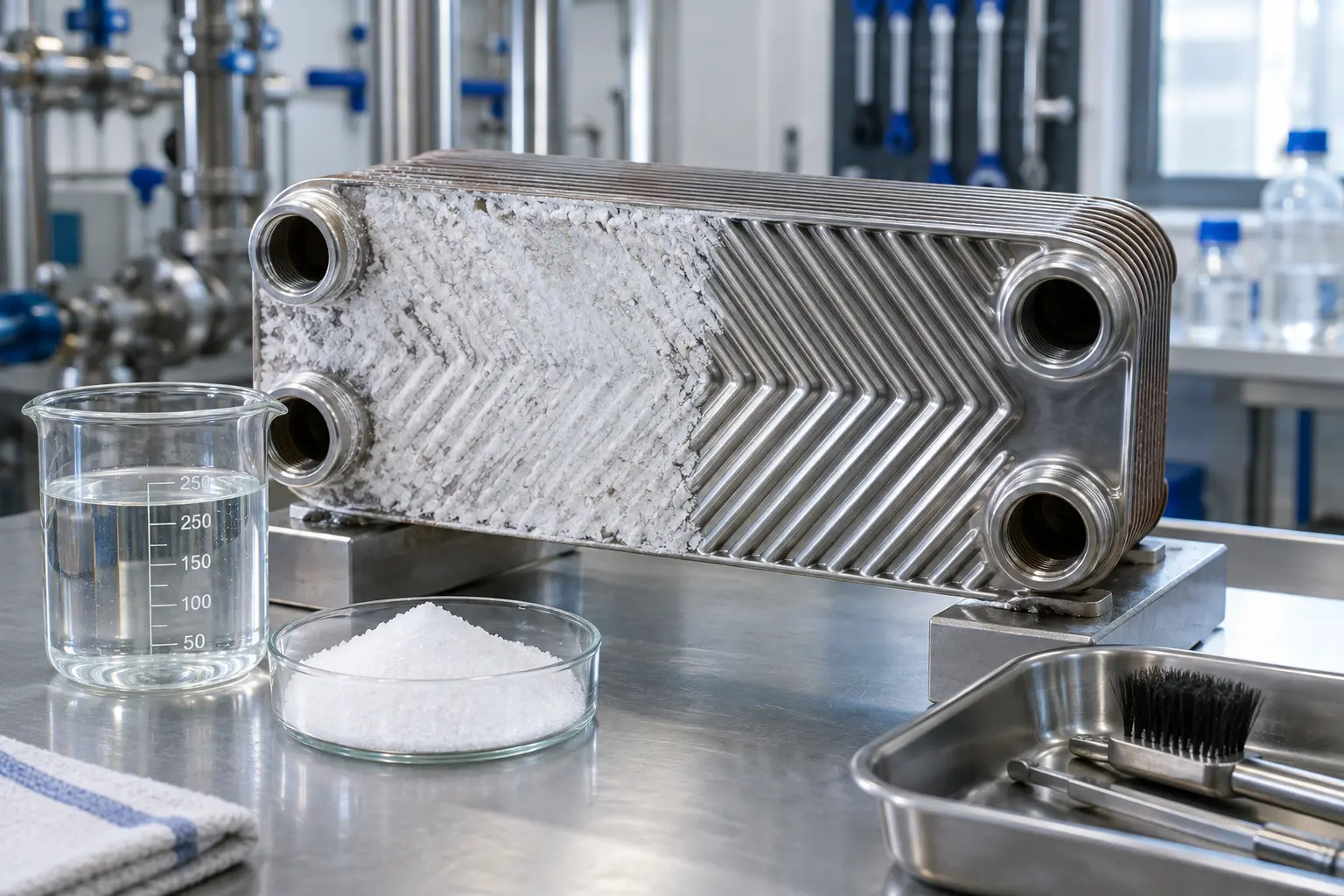
Citric acid removes limescale by supplying hydrogen ions that react with calcium carbonate, the main mineral in most scale deposits. The reaction converts the hard carbonate layer into calcium ions, water and carbon dioxide, while citrate ions help keep calcium in solution so it can be rinsed away. Effectiveness depends on concentration, temperature, contact time, flow and the compatibility of the surface being cleaned.
How citric acid removes limescale is best understood as a combination of acid–carbonate reaction and calcium binding. Limescale develops when hard water leaves calcium-rich mineral deposits on heated or wetted surfaces. Kettles, pipes, plate heat exchangers, evaporators, boilers and food-processing equipment can all accumulate this hard, insulating layer. Citric acid lowers the pH at the deposit surface, breaks down carbonate and helps move the released calcium into the cleaning solution.
This mechanism makes citric acid useful in household and industrial descaling, especially where a milder organic acid is preferred over a highly aggressive mineral acid. However, “milder” does not mean universally safe. The correct procedure must account for scale thickness, equipment metallurgy, seals, operating temperature and the cleaning specification. This guide explains the chemistry, the main operating variables and a controlled approach to citric acid descaling.
What limescale is and why it adheres to equipment
Limescale is a mineral deposit formed primarily from calcium carbonate. Depending on the water source and process, it may also contain magnesium compounds, silica, iron oxides, organic matter or process residues. Heating hard water can drive dissolved bicarbonate toward carbonate formation, making deposits especially common on heating elements and heat-transfer surfaces.
A thin layer can reduce heat transfer, restrict flow, create uneven temperatures and provide a rough surface on which further material accumulates. The deposit may look simple, but its composition and structure vary. A soft, recent calcium-carbonate layer usually responds faster than a dense, aged deposit mixed with silica or corrosion products. For background on the mineral itself, Silvari Group’s guide to calcium carbonate properties and uses explains why this compound behaves differently across applications.
How citric acid removes limescale at the molecular level
Citric acid is a triprotic organic acid, meaning that each molecule can release more than one hydrogen ion in water. At the limescale surface, hydrogen ions react with carbonate. A simplified overall representation is:
3 CaCO3 + 2 H3C6H5O7 → Ca3(C6H5O7)2 + 3 CO2 + 3 H2O
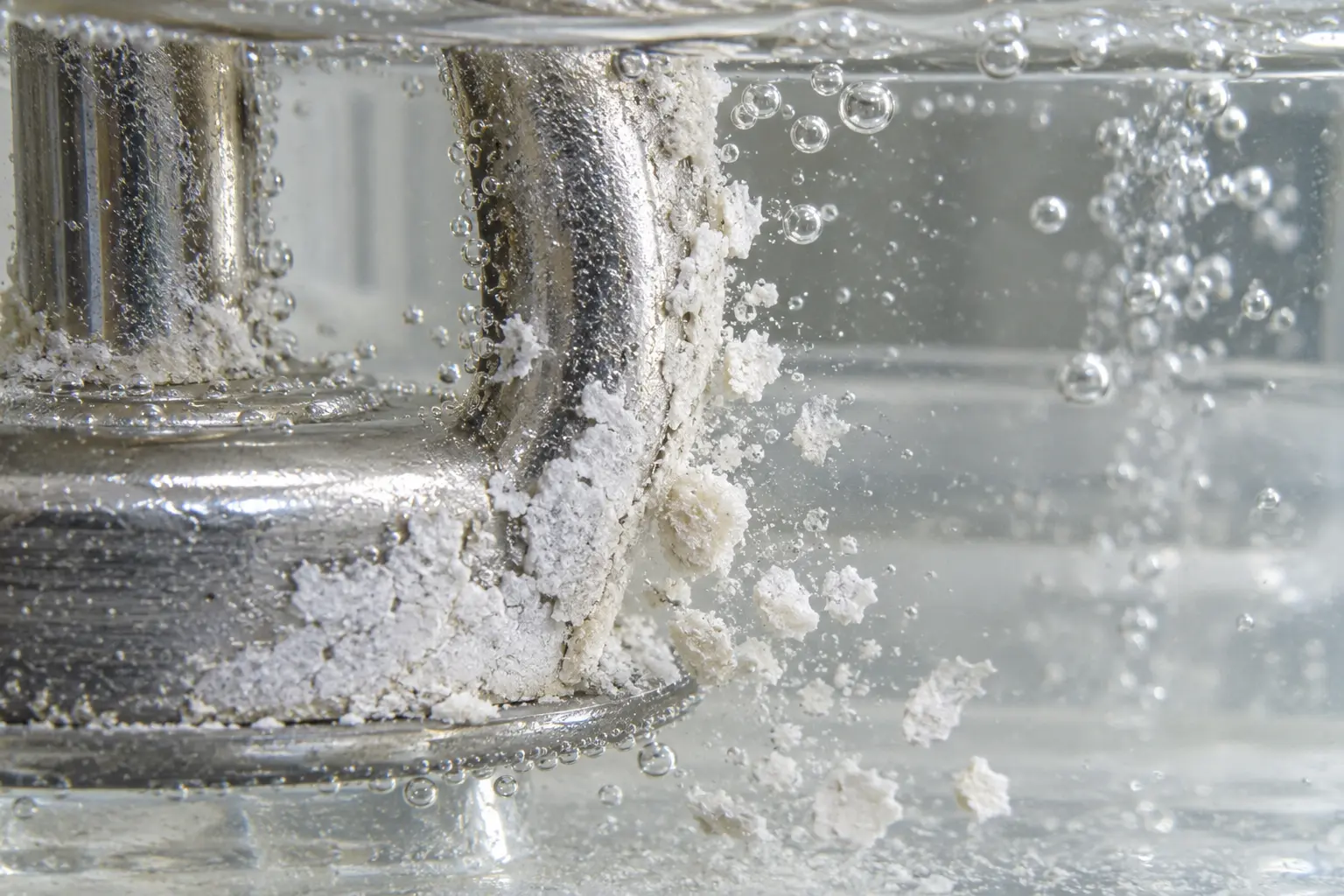
The equation is a useful summary, although a real aqueous cleaning bath contains several citrate species and equilibria. The visible bubbling that sometimes occurs is carbon dioxide escaping as carbonate is neutralised. As the solid structure loses carbonate, calcium ions leave the deposit. Citrate can coordinate with calcium, helping prevent immediate redeposition and allowing the dissolved or dispersed material to be carried away during circulation and rinsing.
Acid reaction and chelation perform different roles
Two related effects are often described as if they were the same. Acidification supplies the hydrogen ions that consume carbonate and disrupt the solid deposit. Complexation, sometimes loosely called chelation in cleaning discussions, describes citrate interacting with released metal ions. The first action attacks the scale; the second helps manage what has been released.
This dual behaviour is one reason citric acid is widely used in formulated cleaners. It can support mineral removal without the volatility associated with some stronger acids. A broader overview of its functions is available in what citric acid is and how it is used. For industrial procurement, grade, assay, particle form and documentation should match the process rather than relying on a generic consumer product; Silvari Group’s industrial citric acid supply page outlines relevant grade and bulk-supply considerations.
Key variables that control citric acid descaling
| Variable | Effect on removal | Practical control |
|---|---|---|
| Concentration | More available acidity can increase capacity, but excessive strength may add cost and material risk. | Start from an approved equipment or cleaning procedure and validate on the actual deposit. |
| Temperature | Moderate warming generally accelerates reaction and mass transfer. | Remain within the limits of metals, gaskets, coatings and the citric acid system. |
| Contact time | Thick or dense scale needs more time for solution to penetrate. | Inspect or monitor the bath rather than assuming a fixed time works for every system. |
| Agitation or flow | Movement brings fresh solution to the surface and removes reaction products. | Use safe circulation where equipment design permits; avoid dead zones. |
| Scale composition | Calcium carbonate responds well; silica-rich or mixed deposits may not. | Identify the deposit before selecting chemistry. |
| Bath loading | The solution loses capacity as it neutralises scale and accumulates calcium. | Track pH or another validated endpoint and replace or adjust the bath when required. |
Why warmer solution often works faster
Higher temperature usually increases reaction rate and improves transport between the liquid and deposit. It can also help dissolve citric acid rapidly during bath preparation. Nevertheless, uncontrolled heating is not automatically better. Excess heat may affect elastomers, coatings or sensitive alloys, and it can make a manual cleaning operation harder to control. Use the temperature range specified by the equipment manufacturer or a validated cleaning protocol.
Why circulation matters in closed equipment
In a stationary bath, the liquid immediately beside the scale becomes progressively loaded with calcium and less acidic. Controlled circulation replaces that boundary layer with fresher solution. It also carries loosened particles out of channels. Flow should reach all wetted paths without exceeding the pressure or velocity limits of the system.
A controlled process for using citric acid on limescale
The following workflow is a general decision framework, not a universal recipe. Industrial cleaning must follow the site’s safety assessment, equipment manual, chemical safety data and wastewater rules.
- Identify the deposit. Confirm that calcium carbonate is a significant component. If the scale contains silica, oil, biofilm or heavy corrosion products, citric acid alone may provide incomplete removal.
- Check material compatibility. Review every wetted material, including the base metal, welds, brazing, coatings, seals and gaskets. Test an inconspicuous area when the compatibility history is uncertain.
- Isolate and pre-rinse. Shut down, depressurise and isolate equipment under the site’s lockout procedure. Remove loose solids and water-soluble residues first.
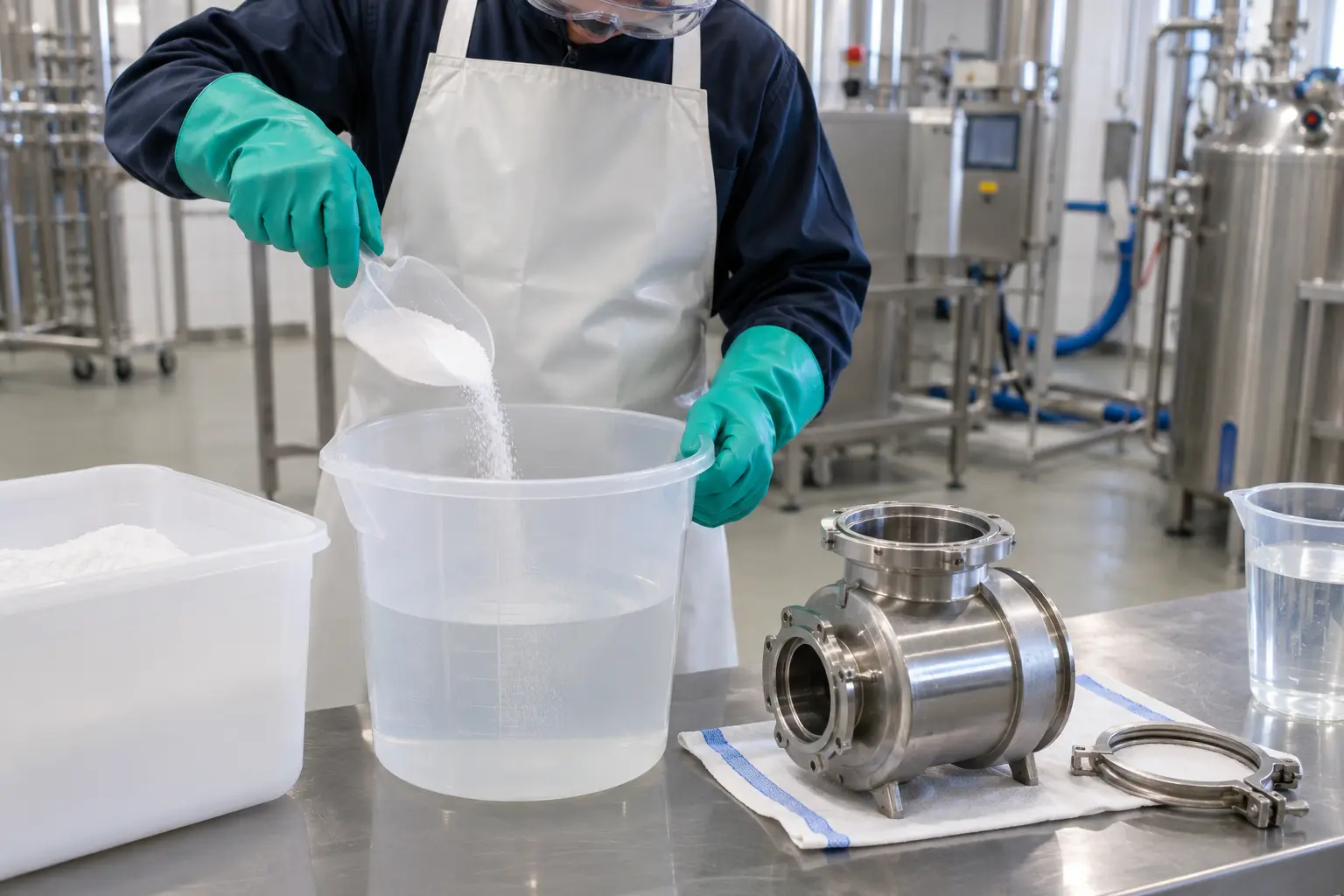
- Prepare a controlled solution. Add chemical according to the approved procedure, using accurate measurement, suitable water and required personal protective equipment. Never mix citric acid with chlorine bleach or an unknown cleaner.
- Apply or circulate. Maintain the validated temperature, flow and contact time. Provide ventilation because carbon dioxide can evolve, particularly in confined cleaning systems.
- Monitor progress. Observe deposit removal and use a defined endpoint such as stable pH, acid consumption, calcium measurement, flow recovery or visual inspection.
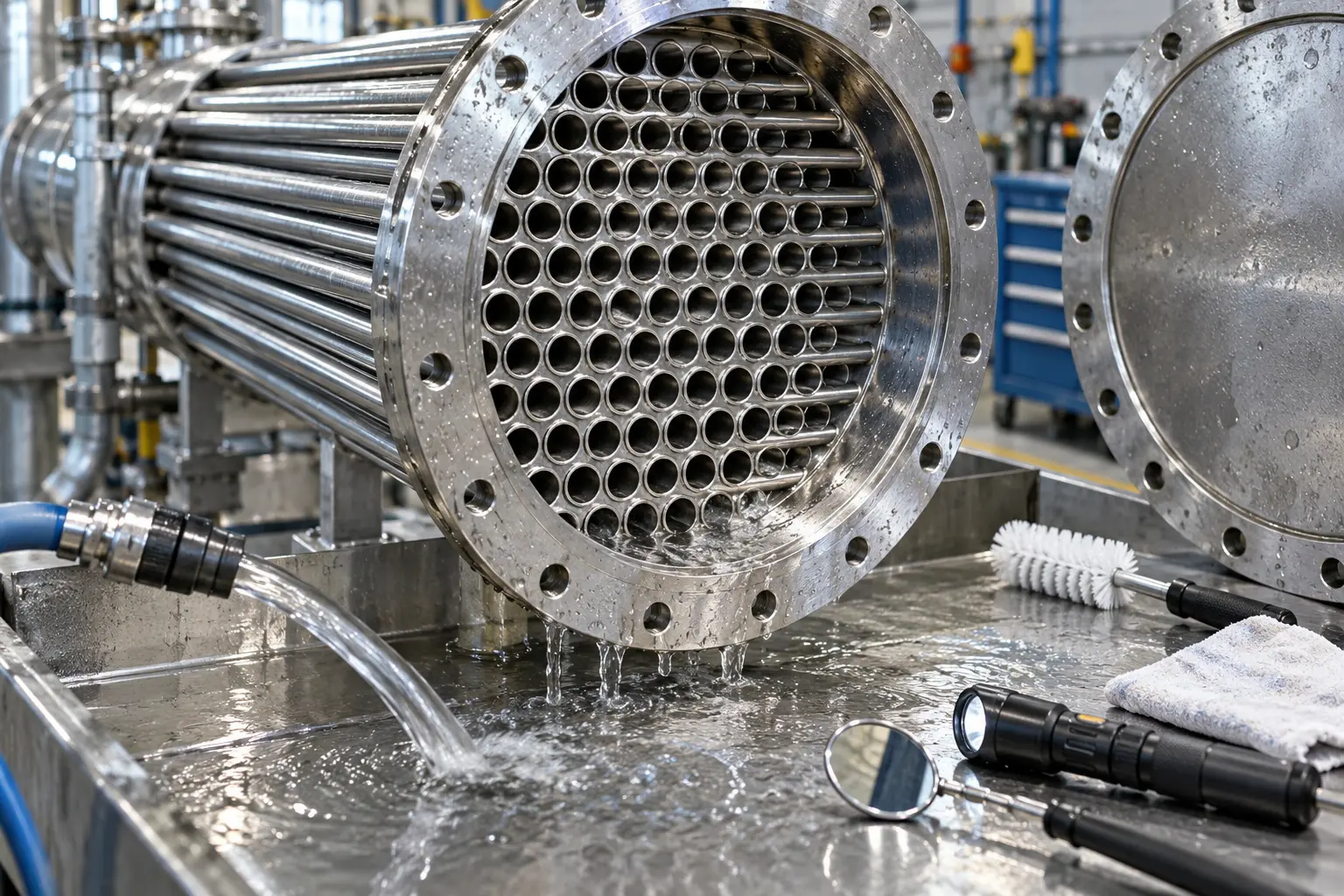
- Drain, rinse and inspect. Manage spent solution under local requirements. Rinse until the acceptance criteria are met, then inspect for remaining scale, flash corrosion, leakage or damaged components.
Where citric acid works well and where it may not
Citric acid is often effective on accessible calcium-carbonate scale found in kettles, stainless-steel vessels, heat exchangers, pipework and certain clean-in-place circuits. Its low volatility and comparatively manageable handling profile can be advantageous in controlled industrial settings. It may also be selected when the operator wants an organic-acid system and can provide sufficient contact time.
It is not the correct answer for every deposit. Silica does not behave like calcium carbonate. Grease may block acid from reaching mineral scale. Iron-rich deposits can require a different formulated approach, and microbiological contamination requires a sanitation strategy rather than descaling alone. Very heavy deposits may need mechanical removal, repeated cycles or an engineered cleaning programme.
Strong mineral acids can dissolve carbonate rapidly, but speed must be balanced against corrosion, fumes, operator exposure and waste handling. The site article on the industrial uses of hydrochloric acid provides useful context on a substantially stronger acid; it should not be treated as an interchangeable household alternative.
Material compatibility and essential safety checks
Stainless steel is commonly cleaned with properly controlled citric acid systems, but alloy grade, weld condition, contaminants, time, temperature and concentration still matter. Aluminium, zinc, galvanised surfaces, natural stone, cementitious materials and some coatings can be attacked or discoloured by acids. Copper alloys, brazed joints and mixed-metal assemblies also require specific review.
Citric acid powder and concentrated solutions can irritate eyes and skin. Avoid dust generation, wear the PPE specified by the safety data sheet and provide clean water for emergency rinsing. Do not seal an actively reacting vessel because carbon dioxide generation can increase pressure. Never combine an acid descaler with hypochlorite bleach: acidification of hypochlorite products can release dangerous chlorine-containing gas.
Authoritative chemical identity and hazard information is available in the NIH PubChem record for citric acid. European manufacturers and professional users should also consult the European Chemicals Agency substance information, the supplier’s current safety data sheet and applicable workplace procedures.
How to verify that limescale removal is complete
The absence of visible white scale is useful but not always sufficient. For heat-transfer equipment, compare approach temperature, energy demand or heat-transfer performance with the clean baseline. For pipework, compare pressure drop and flow. Removable components can be inspected under good lighting, while complex equipment may require a borescope or validated rinse analysis.
Check the surface after rinsing and drying. Persistent roughness may be residual scale, but it may also be pitting or an altered surface that cleaning cannot reverse. A rapid return of deposits usually points to untreated hard water, excessive surface temperature, poor flow, concentration effects or an unsuitable maintenance interval—not necessarily a failed acid.
Preventing limescale after descaling
Descaling restores a surface; it does not remove the cause of deposition. Prevention may include water softening, demineralisation, temperature control, improved circulation, blowdown management or a schedule based on water hardness and equipment performance. The right choice depends on whether the system is potable, food-contact, process-water or utility equipment.
Record the deposit condition, citric acid batch, solution strength, temperature, contact time, monitoring data and post-cleaning result. These records turn an isolated maintenance task into a repeatable process. If scale returns faster than expected, analyse the water and deposit before increasing acid strength or cleaning frequency.
Summary
How citric acid removes limescale comes down to two coordinated actions: acidity breaks calcium carbonate apart, and citrate helps retain released calcium in the liquid phase for removal. The method can be effective and controllable when the deposit is correctly identified and concentration, temperature, circulation and time are validated. Successful descaling also requires material-compatibility checks, appropriate PPE, thorough rinsing, inspection and a plan to control the hard-water conditions that caused the scale.
Frequently Asked Questions (FAQ)
Does citric acid dissolve calcium carbonate?
Yes. Hydrogen ions from citric acid react with carbonate in calcium carbonate, producing carbon dioxide and water while releasing calcium into the solution. Citrate ions can also interact with the released calcium, helping the cleaning bath carry it away.
Why does citric acid fizz on limescale?
The bubbles are mainly carbon dioxide formed during the acid–carbonate reaction. Fizzing indicates that carbonate is reacting, but a lack of visible bubbles does not always mean cleaning has stopped; reaction rate, scale structure and bath loading also affect what can be seen.
Is citric acid safe for stainless steel?
Controlled citric acid cleaning is commonly used with stainless steel, but safety depends on alloy, concentration, temperature, exposure time, welds and contaminants. Follow the equipment maker’s guidance and validate the procedure before cleaning valuable or critical equipment.
Can citric acid remove every type of mineral scale?
No. It is particularly useful for calcium-carbonate scale. Deposits rich in silica, oil, corrosion products or process residues may require pretreatment, another chemistry or mechanical assistance. Deposit analysis prevents ineffective or damaging cleaning.
Can citric acid be mixed with bleach for faster cleaning?
No. Never mix citric acid or any acid descaler with chlorine bleach or an unknown cleaning product. Acidifying hypochlorite can generate dangerous gas. Rinse systems thoroughly between incompatible cleaning stages and follow the site’s chemical-control procedure.