


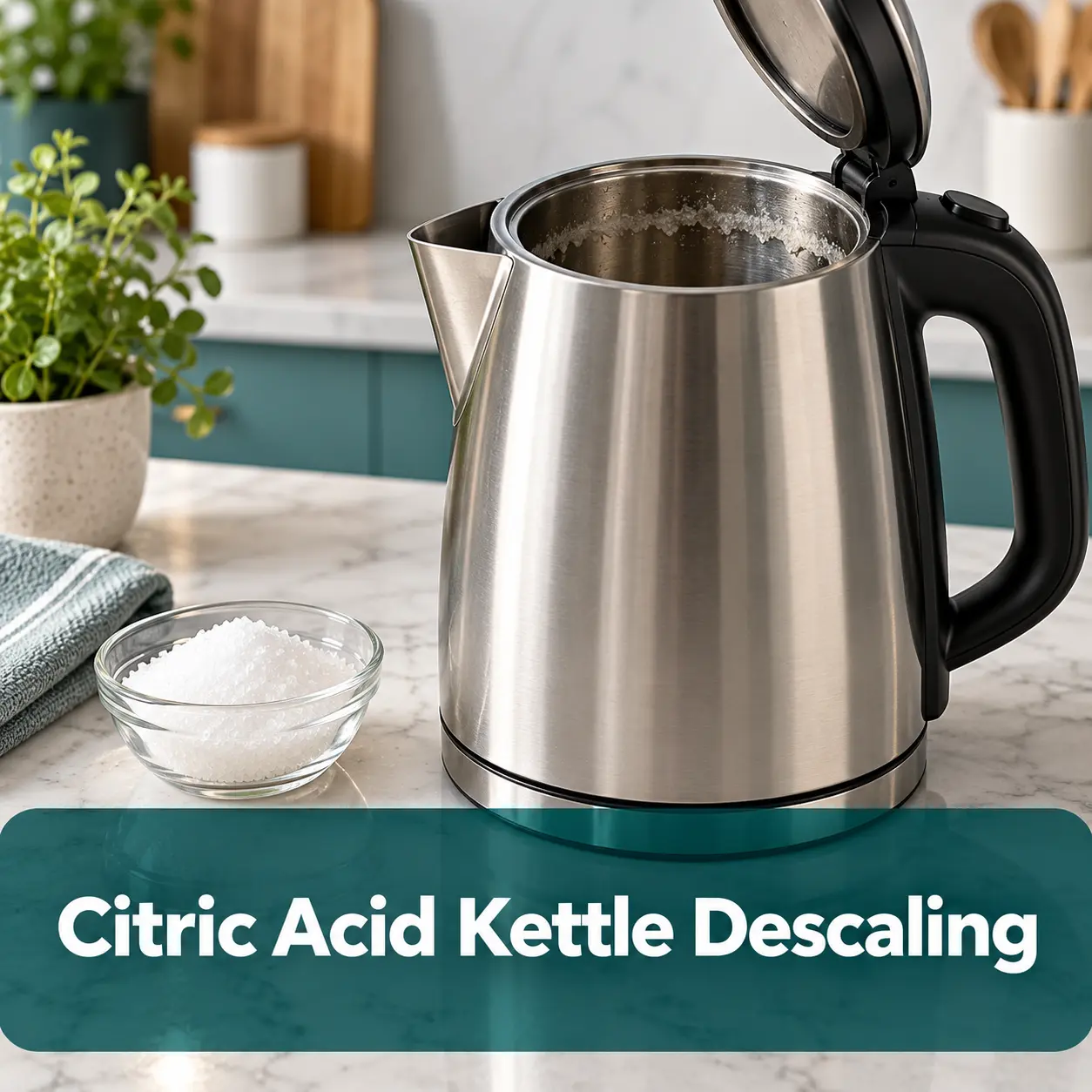
Citric acid kettle descaling can remove chalky mineral deposits from an electric kettle, but the safe method depends on the exact appliance. Bodies, coatings, filters, seals and heating systems differ, and manufacturers do not all give the same cleaning directions. Start with the user manual for your model. If it permits citric acid, follow its dose, preparation, contact time and rinse instructions. If it recommends another descaler or prohibits household acids, use the specified product instead.
A practical citric acid kettle descaling plan begins with model identification, not a guessed spoonful of powder. This guide explains what the acid does, how to check compatibility, what one manufacturer-approved cycle looks like, and how to rinse and inspect the kettle before returning it to service. The example is product-specific; no single concentration or schedule applies to every kettle.
Citric acid kettle descaling: the short answer
Use citric acid only when the kettle manufacturer allows it for your exact model. Acid reacts with much of the calcium-carbonate scale that forms in hard-water areas, loosening mineral deposits from accessible surfaces. That chemistry cannot establish compatibility with every material, coating, filter or seal. The appliance manual remains the controlling instruction.
- Find the full model number and read the matching manual.
- Check the approved descaler, dose, temperature, contact time and rinse steps.
- Unplug the kettle before handling solution; never immerse its base, plug or cord.
- Do not combine citric acid with bleach, chlorine cleaners, vinegar or another descaler.
- If instructions are unavailable or unclear, ask the manufacturer rather than guessing.
Business readers comparing product grades and supply formats can review Silvari’s citric acid grades and bulk supply information. Household appliance instructions still determine whether a product is suitable for a kettle.
Why kettles develop limescale
Tap water contains dissolved minerals. In hard-water regions it may carry more calcium and magnesium compounds. When water is heated repeatedly, mineral deposits can form on a heating plate, concealed element or inner wall. Scale may look like a white crust, a cloudy film or a layer around the water-level line and removable filter.
The amount of buildup depends on local water hardness, frequency of use, how much water remains in the kettle and appliance design. Scale can slow heating or contribute to noise, but those symptoms can have other causes. A descaling cycle will not repair a faulty switch, damaged cord, leaking housing or electrical problem. Stop using a damaged kettle and seek service.
The need for citric acid kettle descaling varies with visible deposits, water conditions and the maker’s maintenance schedule. If the manual gives an interval, follow it. Otherwise, inspect the kettle regularly instead of treating on an automatic schedule. Emptying leftover water after use may reduce standing mineral residue; clean a removable filter separately as directed.
How citric acid acts on scale
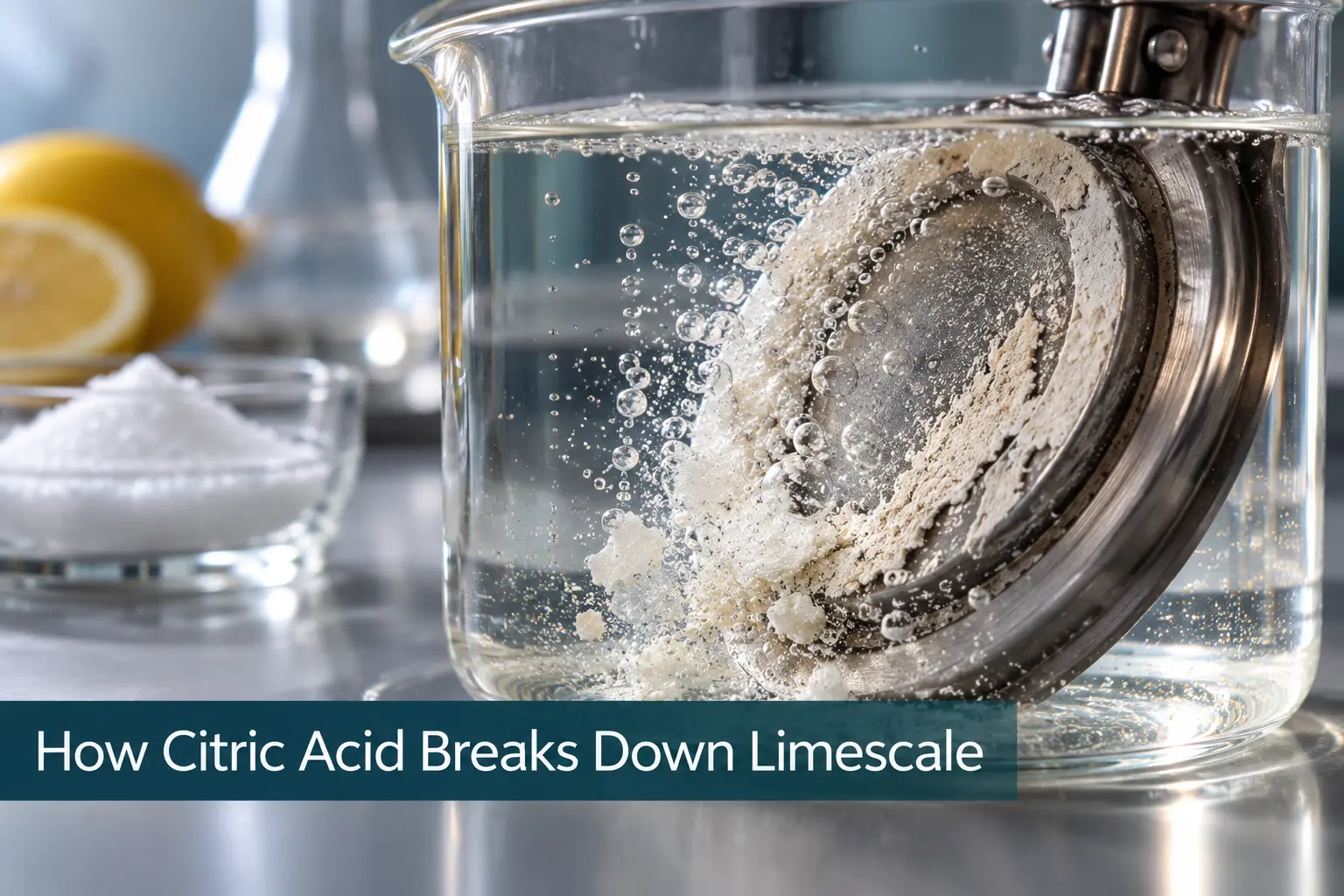
Much kettle scale is calcium carbonate. In an acidic solution, hydrogen ions react with carbonate, producing dissolved calcium species, water and carbon dioxide. This explains why deposits may loosen and why light bubbling can occur when fresh solution contacts carbonate. Citrate ions can also interact with calcium in solution.
A visible reaction is not a safety test. Strong or prolonged acid exposure may affect a component that was not designed for it. Concentration, temperature, contact time and kettle construction all matter. A clear-looking liquid does not prove that residue is gone, and fizzing does not mean more acid or longer soaking is necessary.
For that reason, citric acid kettle descaling is a controlled maintenance task, not an internet recipe. For a broader comparison, read this side-by-side comparison of citric acid and vinegar; it does not override a kettle maker’s instructions.
Check the manual before preparing a solution
Treat citric acid kettle descaling as model-specific. Locate the rating label, often on the underside of a cordless kettle or near its base, and record the complete model code. Search the manufacturer’s support site for that code and open the relevant manual or care page. Similar-looking kettles may have different coatings, filters or controls, so a brand name alone is not enough to establish compatibility.
What to confirm in the model instructions
- Allowed cleaner: look for citric acid, a citric-acid-based descaler or a named product. If household acids are prohibited, follow that restriction.
- Full procedure: note whether the solution is heated, whether the kettle must be unplugged, how long it stands and how many rinses are required.
- Separate components: a removable mesh filter may have its own care steps. Do not assume that a method for the body also applies to accessories.
- Warnings: check cautions for plastic, painted or coated interiors, concealed heating elements and water-level windows.
- Correct manual revision: directions can vary by model generation and market. Ask manufacturer support if the label and online manual do not match.
Manufacturer directions show why checking matters. For its Element 1.7 L KI280D10, Tefal’s official care instructions describe one citric-acid method: boil half a litre of water, add 25 g citric acid, leave for 15 minutes, then empty and rinse five or six times. The same page says to follow the maker’s directions for a specific descaler and use only recommended descaling methods. This is an example for that listed product, not a universal dose or procedure.
A safe, model-specific workflow
Before you begin citric acid kettle descaling, read the instructions beside the cleaner label and prepare only what they specify. This checklist organizes the task but does not replace the manual. If its sequence differs from a step here, follow the manual.
Prepare and complete only the permitted cycle
- Clear the area. Use a stable, dry counter away from children and pets. Keep the base and cord dry, and pour where splashes can be controlled.
- Switch off and unplug. Let a recently boiled kettle cool to the temperature specified. Never handle a hot or live appliance while mixing solution.
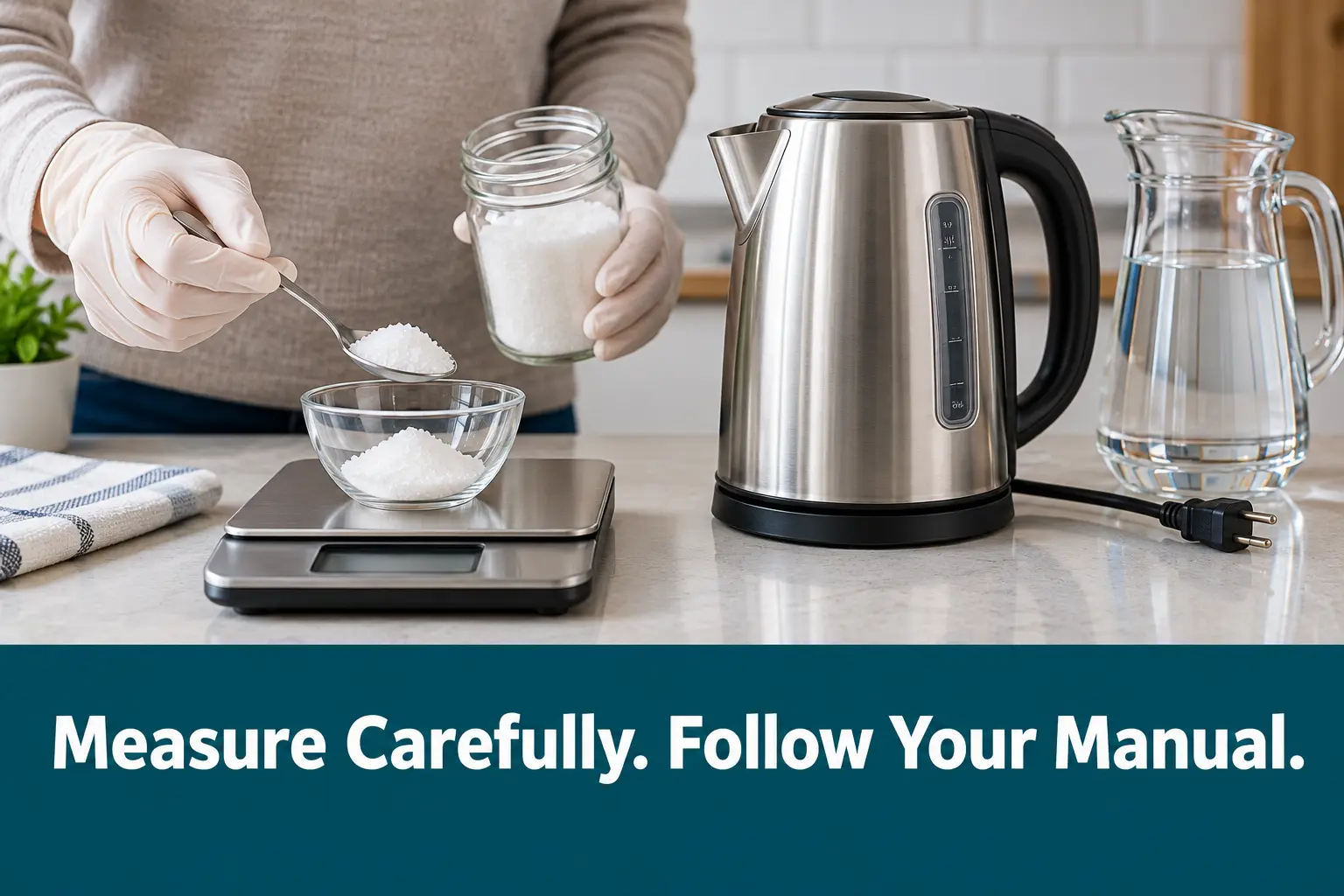
- Measure the approved amount. Use a clean scale or vessel if specified. Do not estimate, increase the amount for thick deposits or borrow a dose from another appliance.
- Prepare as directed. Follow the manual’s order for water and acid, and whether to heat or let it stand. If it says not to boil the solution, do not boil it. Avoid leaning over the opening.
- Stay below the fill limit. Never overfill. Do not switch the kettle on unless its instructions require a heating step, and do not leave it operating unattended.
- Respect contact time. Start a timer and use the stated duration. Longer exposure is not automatically more effective.
- Empty carefully. Keep the lid away from your face and hands. Pour slowly, taking care with warm solution and loosened deposits.
- Clean removable parts separately. Detach only components the manual identifies as removable. Brush a filter gently only if permitted; avoid scouring pads, metal tools and abrasive powders.
- Rinse exactly as specified. Use fresh water and complete every rinse. Do not rely on smell or appearance alone.
- Inspect before use. Check for visible scale, surface damage, leaks or unusual residue. Repeat only if the manufacturer permits it; ask support if deposits remain.
Rinse thoroughly before making drinks
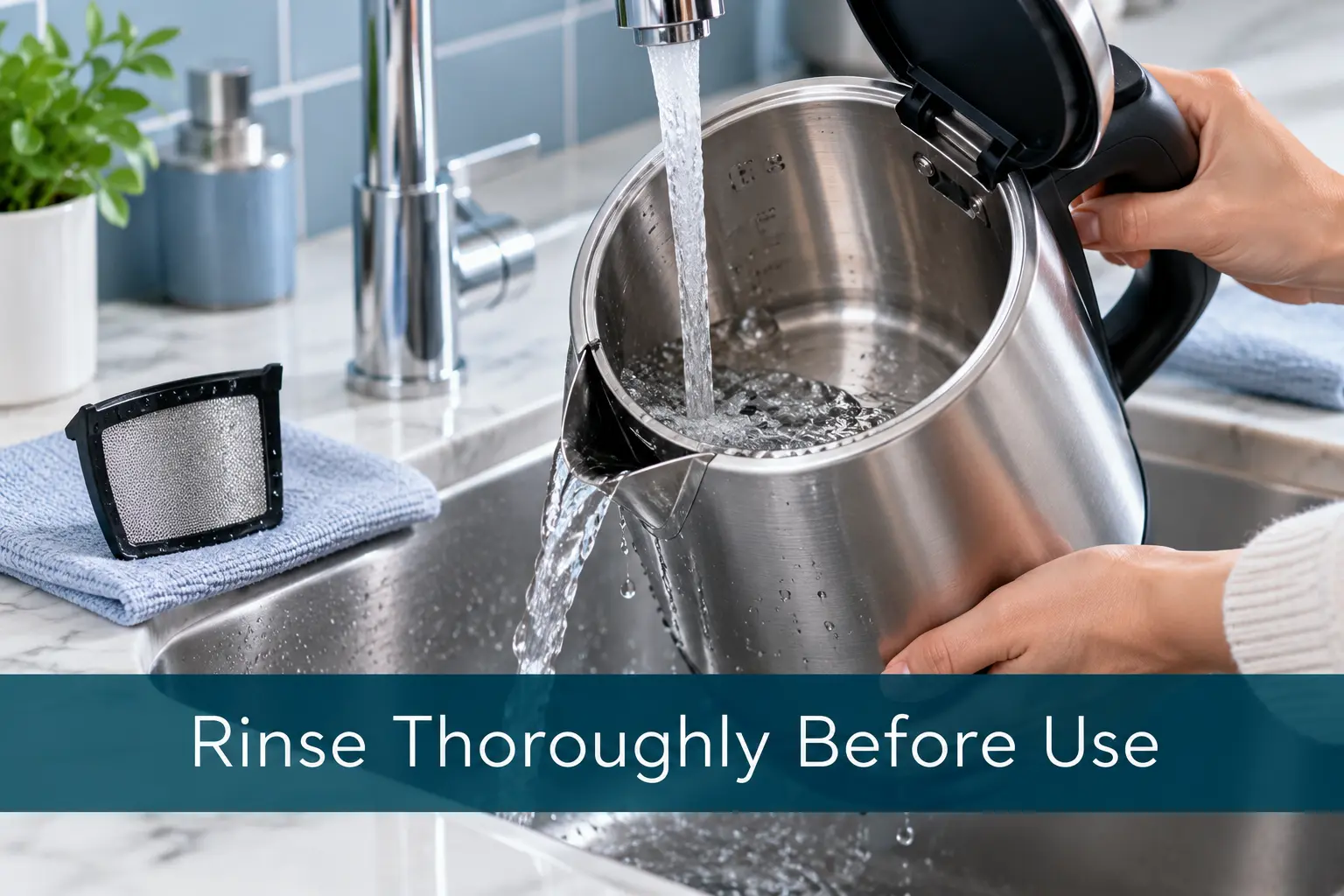
After citric acid kettle descaling, rinsing is part of the process, not an optional finishing touch. Empty the solution completely, then follow the stated rinse sequence. Some makers specify a number of rinses; others direct users to fill, boil and discard fresh water. Use the method for your model and keep the plug and base away from splashes.
Clean and dry the exterior with a soft cloth if needed. Wipe only the outside unless the manual says otherwise. Do not immerse the kettle or electrical base. Let the appliance dry as recommended and reinstall a removable filter in the correct position before boiling drinking water.
If the kettle still has an unusual taste after the full rinse procedure, do not use it for beverages. Repeat rinsing only if permitted; contact the manufacturer if the issue persists. A chemical smell, visible film, corrosion, damaged coating or leak is a reason to stop and seek advice rather than add another cleaner.
What not to do during kettle descaling
- Do not mix cleaners. Never mix citric acid with bleach or chlorine-containing products. Acid and bleach can release chlorine gas, which can injure eyes and the respiratory system. Poison Control explains the risk of mixing bleach and acids.
- Do not combine descalers. Do not add vinegar, detergent, bleach or another acid to the same cycle.
- Do not guess a dose. Advice for a stainless kettle may be unsuitable for a coated, plastic or differently designed model.
- Do not scrub aggressively. Abrasives and metal tools can scratch surfaces or damage filters.
- Do not treat every fault as scale. Electrical problems, leaks, burning smells and damaged cords require service, not chemical cleaning.
- Do not reuse a kettle procedure elsewhere. It is not an instruction for a coffee machine, humidifier, boiler or industrial system. For separate model-specific advice, read our guide to descaling coffee machines according to their manuals.
How often should you descale an electric kettle?
Follow the maker’s maintenance schedule. If there is no fixed interval, inspect the kettle and adjust based on actual scale, water hardness and use. A home with hard water and frequent boiling may see deposits sooner than one with softer water and occasional use. Visible buildup is a cue to consult the manual, not proof that a stronger solution is required.
Habits can slow visible buildup: empty leftover water after use if recommended, allow the kettle to dry and clean a removable anti-scale filter at the stated interval. These steps do not eliminate dissolved minerals, so periodic descaling may still be necessary. Avoid water treatments or additives unless the maker approves them.
When citric acid is not the right choice
Do not use citric acid if the manual prohibits it, specifies a formulated cleaner, or cannot be verified. Ask the manufacturer about compatibility if the kettle has an unusual interior, damaged surfaces, heavy deposits, persistent taste or an unclear model label. Support can confirm the process or recommend service.
For organizations sourcing citric acid for a separate industrial or formulation use, household kettle guidance is not a product specification. Check grade, documentation and application with your technical or procurement team. Silvari’s team contact page for product documentation inquiries can route business questions. Do not use a bulk ingredient in an appliance unless its maker and product labeling support that use.
Summary: the safe decision path
| Situation | Action | Reason |
|---|---|---|
| Manual permits citric acid | Follow its exact dose, timing and rinse steps | Compatibility is model-specific |
| Manual names a branded descaler | Use that product as instructed | Formulated products differ |
| Manual is missing or unclear | Ask support with the model code | Avoid guessing at chemical compatibility |
| Acid and bleach were mixed | Leave the area, get fresh air and contact local poison or emergency advice | Hazardous chlorine gas may form |
| Kettle leaks or has electrical damage | Stop using it and seek repair | Descaling cannot repair a fault |
Conclusion
In summary, citric acid kettle descaling can remove carbonate scale when the kettle maker approves the method and the full procedure is followed. Confirm the model, use only the stated product and amount, respect contact time, keep electrical parts dry and complete every rinse. If compatibility is uncertain or the kettle shows damage, pause and ask the manufacturer. Model-specific directions are more reliable than a one-size-fits-all recipe.
Frequently asked questions
1. Can I use citric acid to descale any electric kettle?
No. Use it only when instructions for your exact model allow it. Materials, coatings and filter designs vary.
2. What is the correct citric acid dose for a kettle?
There is no universal dose. Follow the manual. Tefal’s KI280D10 care page is one product-specific example; do not transfer its amount to another model unless its maker says so.
3. Should I boil citric acid solution in the kettle?
Only if the manual explicitly instructs you to heat or boil the solution. Some procedures require a stand or soak instead.
4. How many times should I rinse the kettle?
Use the rinse count and method in the manual. Complete every rinse before using the kettle for drinking water.
5. Can I mix citric acid with vinegar or bleach?
No. Never combine cleaning products in a kettle. Acid and bleach can produce chlorine gas.
6. How do I know when a kettle needs descaling?
Look for visible deposits or follow the maintenance alert and schedule in the manual. Hard water and frequent use can make scale appear sooner.