



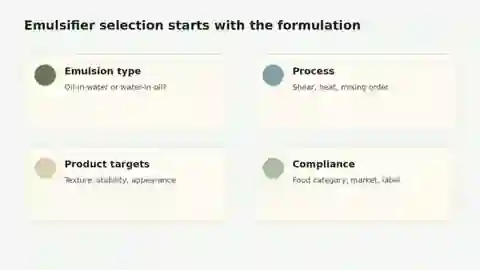
Choose a food emulsifier by matching the emulsion type, oil phase, water phase, process conditions, desired texture, label requirements and shelf-life target. Start with a small candidate set, test each option at realistic use levels, then confirm performance through stress, pilot and shelf-life trials before scale-up.
how to choose food emulsifier is ultimately a formulation decision rather than a simple ingredient lookup. Two emulsifiers can perform very differently when the oil composition, pH, ionic strength, heat treatment, shear, solids content or storage temperature changes. The best choice is therefore the one that creates and maintains the required structure under the actual conditions of the product and manufacturing line.
This guide provides a practical selection workflow for food developers, procurement teams and manufacturers. It focuses on the questions that narrow the candidate list quickly, the tests that reveal hidden instability, and the documentation that matters when a formulation moves from bench scale to commercial production.
Start with the emulsion system you need to stabilize
Before comparing ingredients, define what is being dispersed and what is continuous. In an oil-in-water system, oil droplets are dispersed through a continuous water phase; in a water-in-oil system, the arrangement is reversed. The interfacial requirements, processing sequence and suitable emulsifier systems can therefore differ substantially.
If the product is unfamiliar, reviewing the basic mechanism of food emulsifiers is useful because selection starts at the oil-water interface. An emulsifier must adsorb at that interface quickly enough during mixing or homogenization and form a layer that resists droplet coalescence afterward.

Record the oil fraction, water fraction, viscosity, solids level and any proteins, hydrocolloids, salts or acids present. These variables affect droplet formation and the forces between droplets. A candidate that performs well in a simple laboratory oil-water model may not remain effective in a complete recipe.
How to choose food emulsifier candidates efficiently
A useful first screen combines technical function with practical constraints. Instead of asking which emulsifier is “best,” ask which options are compatible with the product architecture and process. This prevents unnecessary trials and makes the final decision easier to justify.
| Selection factor | What to define | Why it matters |
|---|---|---|
| Emulsion type | Oil-in-water or water-in-oil | Changes interfacial and phase-affinity requirements |
| Process | Shear, homogenization, heat, order of addition | Controls droplet formation and emulsifier adsorption |
| Product chemistry | pH, salts, proteins, sugars, hydrocolloids | Can strengthen or disrupt the stabilization mechanism |
| Texture target | Thin, creamy, aerated, spreadable or firm | Emulsification interacts with viscosity and structure |
| Storage | Ambient, chilled, frozen, heat-cycled | Instability may appear only under shelf-life stress |
| Commercial fit | Label, regulatory status, supply form and cost-in-use | A technically strong option must also be feasible to source and use |
Match phase affinity to the formulation
Hydrophilic-lipophilic balance, commonly abbreviated HLB, can be a useful screening concept for some surfactant systems, but it should not be treated as a universal pass/fail number. Real foods often contain mixed oils, proteins, particles and other surface-active materials. Use HLB or supplier guidance to create a shortlist, then let formulation testing determine the winner.
Consider emulsifier source and physical form
Lecithin is a common option in food systems and may be supplied in liquid or de-oiled powder formats depending on application and handling needs. The lecithin product overview provides an example of how source and physical form can differ even within one ingredient family. Soy- and sunflower-derived options may also carry different labeling or sourcing implications for a particular market.
Other systems can use mono- and diglycerides, polysorbates or blended emulsifier packages. For a concrete example of a different functional profile, see the discussion of polysorbate 80 in foods. Comparing candidates by mechanism and application is more useful than substituting one ingredient one-for-one without trials.
Evaluate processing conditions before locking the formula
Emulsification happens during a process, not only on a specification sheet. Mixing energy determines how quickly phases are brought together, while homogenization pressure or rotor-stator conditions influence droplet size. Temperature affects viscosity and the physical state of fats. The order of addition can change how quickly an emulsifier reaches the interface.
For every candidate, document where it is added, whether pre-dispersion is required, the temperature at addition, hydration time if relevant and the shear applied before and after phase combination. A formula that only works under a narrow laboratory procedure may become unreliable when transferred to a production line.
Heat and cooling can expose weak systems
Pasteurization, cooking, hot filling and cooling can alter proteins, fat crystals and viscosity. An emulsion that looks stable immediately after high shear can separate hours later as the product cools. If the commercial process includes thermal treatment, reproduce the same heating and cooling profile during development rather than evaluating the sample only at room temperature.
pH, salts and proteins can change interfacial behavior
Acidification and mineral salts alter electrostatic interactions, while proteins may compete with small-molecule emulsifiers for the interface. This is especially important in beverages, sauces and dairy or plant-protein systems. Add acids, salts and proteins in the intended manufacturing sequence and evaluate the final pH, not an idealized base formula.
Separate emulsification from overall product stabilization
An emulsifier primarily helps create and stabilize the interface between phases. The final product may still need viscosity control, suspension or gel structure from other ingredients. Confusing these jobs can lead to excessive emulsifier use when the actual problem is sedimentation, low continuous-phase viscosity or an unsuitable hydrocolloid system.
Define the failure mode precisely. Creaming means droplets are moving because of density differences; coalescence means droplets are merging; sedimentation concerns heavier particles; syneresis involves liquid release from a structured phase. Each failure suggests a different formulation response. A useful troubleshooting plan therefore measures what is changing rather than simply adding more emulsifier.
Run a structured comparison instead of one-off trials
Once the shortlist is small, compare candidates under the same conditions. Keep oil level, total solids, mixing sequence, shear and sample size constant. Test a practical range of use levels around supplier recommendations, but do not assume more is always better. Excess surface-active material can affect flavor, aeration, texture, foaming behavior or cost without solving the underlying instability.
Use measurable acceptance criteria
Define success before the trial. Depending on the product, useful endpoints can include droplet-size distribution, separation height, viscosity, appearance, overrun, texture, centrifuge response or sensory performance. Establishing limits in advance makes it easier to distinguish a meaningful improvement from normal batch variation.
Stress the system before pilot scale
Accelerated screens cannot replace a validated shelf-life study, but they can identify weak candidates earlier. Depending on the product, relevant stresses can include temperature cycling, chilled storage, centrifugation, freeze-thaw exposure or controlled agitation. Choose only stresses that reflect plausible product risks and interpret them as comparative tools rather than as automatic shelf-life predictors.

Check regulatory, labeling and sourcing requirements early
Technical performance is only one part of the decision. Confirm whether the emulsifier is permitted for the intended food category and market, what conditions of use apply and how it must be declared. The U.S. FDA lists emulsifiers among common food-ingredient functions and gives examples such as soy lecithin, mono- and diglycerides and polysorbates in its overview of food ingredient types. In Europe, the EFSA food additives overview explains the evaluation framework and notes the E-number system used for authorized additives.
Requirements can differ by jurisdiction and product category, so verify the current legal status for the actual market before commercialization. Also confirm allergen implications, source declarations, non-GMO or identity-preserved requirements where relevant, and customer-specific specifications.
Procurement should review supply reliability at the same stage. A candidate may perform perfectly in a lab but still be unsuitable if the required grade, source, documentation or packaging format cannot be supplied consistently. For lecithin projects, the lecithin sourcing information for Europe illustrates the type of grade and traceability considerations that should be aligned with technical requirements.
For broader ingredient governance, it is also useful to distinguish application performance from the controls associated with a food-grade chemical or ingredient. Specifications, certificates and traceability do not replace formulation testing, but they are essential to a commercially usable choice.
Scale up with the process window, not just the final recipe
Pilot trials should confirm that the selected system tolerates normal manufacturing variation. Record acceptable ranges for temperature, mixing time, shear, hold time and addition sequence. If stability collapses when one parameter moves slightly, the formulation may be too fragile for reliable production.
During pilot work, collect samples at meaningful points: after pre-mixing, after homogenization, after thermal treatment and after filling. This helps separate formulation issues from equipment or process issues. It also provides a clearer basis for corrective action if commercial batches later drift from target.
Practical decision checklist for formulation teams
- Define the emulsion: identify continuous and dispersed phases, oil level and major surface-active ingredients.
- Set the process: document shear, homogenization, heat treatment, cooling and addition order.
- Shortlist candidates: use phase affinity, supplier guidance, source, physical form and label constraints.
- Compare fairly: test candidates under identical conditions at justified use levels.
- Measure failure: distinguish creaming, coalescence, sedimentation, syneresis and texture changes.
- Stress-test: use relevant comparative stresses before committing to pilot scale.
- Verify compliance: confirm current permissions, labeling, specifications and documentation for the destination market.
- Validate scale-up: prove the formula works across a realistic manufacturing process window.
conclusion
Knowing how to choose food emulsifier means connecting ingredient chemistry with the real product, process and supply chain. Start by defining the emulsion and failure risks, shortlist technically compatible candidates, compare them under controlled conditions, and then validate the preferred option through stress, pilot and shelf-life work. The most reliable choice is the one that repeatedly meets product targets under realistic manufacturing and storage conditions.
Frequently Asked Questions
1. What is the first step when selecting a food emulsifier?
Define the emulsion type, oil and water phases, major ingredients, process conditions and the stability problem you need to control. This creates a technically relevant shortlist before bench testing begins.
2. Is HLB enough to choose an emulsifier?
No. HLB can be a useful screening tool for some surfactant systems, but real food formulations also depend on proteins, salts, pH, oil composition, processing and storage. Final selection should be based on trials in the complete formulation.
3. Can lecithin replace another emulsifier one-for-one?
Not reliably. Lecithin has useful interfacial properties, but performance depends on source, grade, physical form and the formulation itself. Replacement trials should compare stability, texture, processing behavior and sensory effects.
4. How should emulsifier performance be validated before scale-up?
Use controlled bench comparisons, relevant stress tests, pilot production and shelf-life evaluation. Keep process variables documented so the selected system can be reproduced at commercial scale.
5. Why can an emulsion fail after looking stable at first?
Instability may develop during cooling, storage, temperature cycling or interaction with salts, proteins and other ingredients. Immediate visual stability therefore does not prove long-term performance.