



Citric acid coffee machine descaling is often suggested as a simple do-it-yourself fix for limescale, but a coffee machine is a compact hydraulic and heating system with model-specific materials, seals, valves, sensors and rinse cycles. Citric acid can dissolve calcium-carbonate scale, yet that chemistry alone does not prove that a homemade mixture is suitable for your appliance. The safe rule is straightforward: read the exact model’s manual first, and use citric acid only when the manufacturer or the approved descaler instructions explicitly allow it.
This guide explains why coffee machines scale, what citric acid does and how to complete a controlled descale and rinse. It gives no universal concentration or cycle time; appliance designs and manufacturer instructions differ. Citric acid coffee machine descaling should always follow the model-specific directions.
Citric acid coffee machine descaling: the short answer
Citric acid can remove mineral scale in some coffee machines, but it is not a universal appliance-safe remedy. Some manufacturers specify a citric-acid-based descaler for particular product lines; other brands advise against household citric acid and vinegar. For example, Philips’ SENSEO guidance says to use citric-acid-based descalers suitable for those machines, while Nespresso says household remedies including citric acid are not recommended for its Original and Vertuo machines. These are model-family-specific instructions, not contradictory universal chemistry rules. Follow the manual for your exact model and region.
If the manual permits a citric-acid-based product, use the product and cycle exactly as directed. If it tells you to use the brand’s formulated descaler, do that instead of improvising. If the manual is missing or unclear, identify the model number and ask the manufacturer’s support team before adding acid to the water tank.
Why coffee machines develop limescale
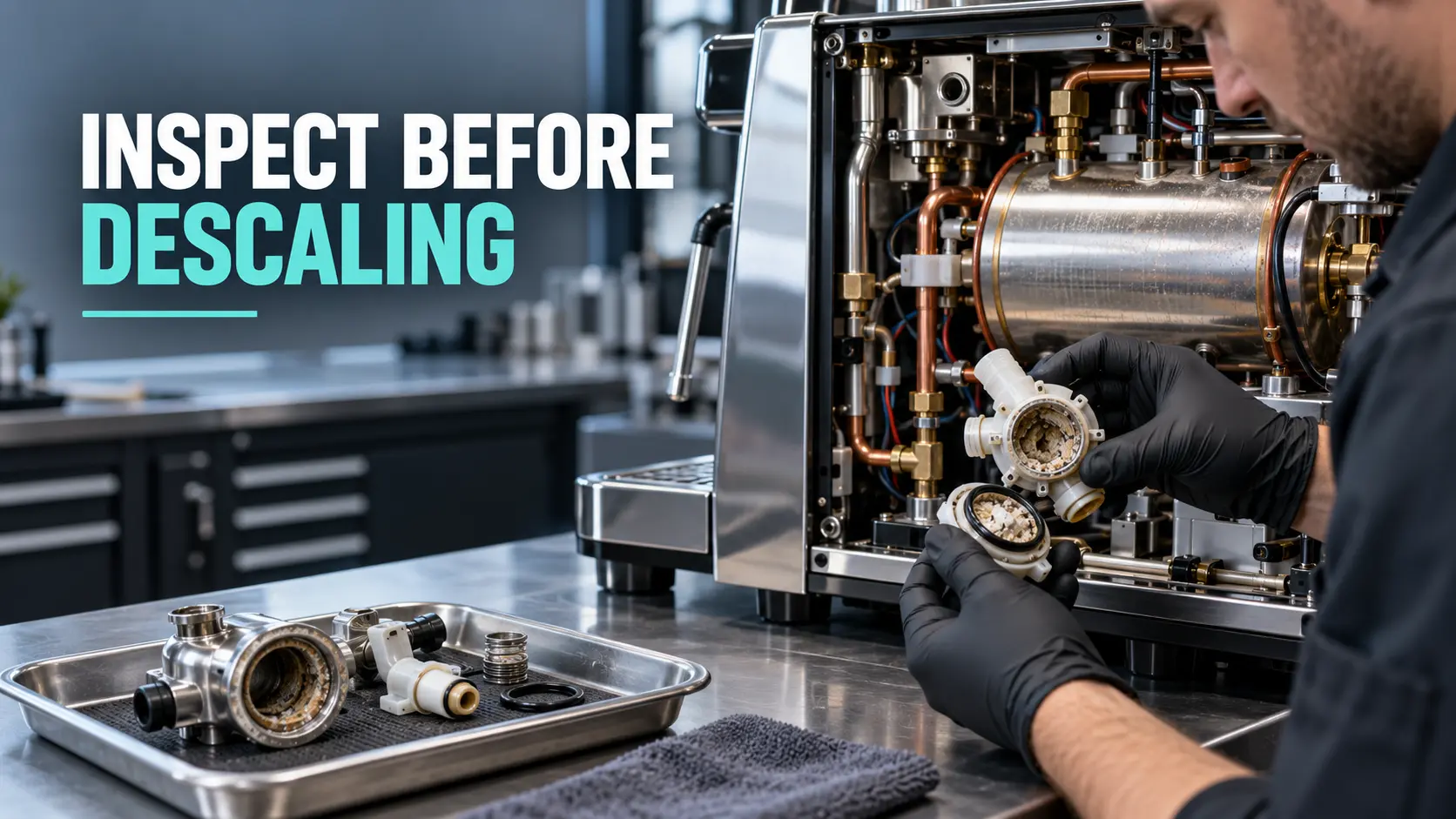
Hard water contains dissolved calcium and magnesium. When it is heated inside a thermoblock, boiler or narrow pipe, some minerals can precipitate and build up as scale. The rate depends on the local water hardness, how much water passes through the machine, temperature, heating cycles and whether a water filter is installed and maintained. The visible clue may be a chalky mark around a water outlet, but internal deposits can develop before there is obvious external evidence.
Scale can restrict small passages, slow water flow, affect temperature stability and increase the time needed to heat water. A machine may also display a descale alert based on a programmed counter or water-hardness setting. That reminder is useful, but it does not identify every fault: a weak espresso, low volume or unusual noise can also result from a clogged filter, coffee oils, a pump issue or another maintenance need.
Descaling targets inorganic mineral deposits. It is not the same as cleaning coffee oils from a portafilter or brew group, removing milk residue from a steam wand, or sanitizing a water circuit. Use the separate cleaning products and routines stated in the appliance manual. Do not put espresso detergent, bleach, vinegar, citric acid or another cleaner into a circuit unless the exact manual directs that use.
How citric acid reacts with scale
Much limescale is calcium carbonate. In an acidic solution, carbonate reacts with hydrogen ions and is converted to dissolved calcium species, water and carbon dioxide. The small bubbles sometimes seen during descaling are consistent with carbon dioxide formation. Citric acid is a weak organic acid with three acidic groups, and citrate can interact with calcium ions in solution. This makes citric acid useful in some formulated descalers, but it does not automatically make every concentration, temperature or homemade recipe compatible with every machine.
The final result also depends on the formulation and process. A manufacturer’s descaler may combine acids, inhibitors or other ingredients and specify a rinse sequence. Simply matching one ingredient name does not reproduce that product. Concentration, contact time and temperature affect both scale removal and exposure of metals, coatings, elastomers and adhesives. Under some conditions, dissolved calcium and citrate can form deposits as the solution chemistry changes. Proper flow and rinsing matter as much as the acid selected.
For this reason, treat citric acid coffee machine descaling as a maintenance procedure governed by the machine manufacturer, not as a kitchen recipe. Do not assume a mixture used successfully in a kettle, shower head or another model is appropriate. Accurate acid handling and safe-use information also depends on the specific substance and use case.
Check your specific machine before using citric acid
Start with the model code printed on the machine’s label or shown in its settings. Download the current owner’s manual from the manufacturer’s support page and look for the sections on descaling agents, water hardness, filters, descaling alerts and rinse cycles. Instructions may differ between product families, generations and regional variants, even when the machine exterior looks similar.
- Identify the exact model. Record the full model number, not just the brand or series name.
- Check approved chemistry. Look for explicit permission to use a citric-acid-based descaler or a requirement to use a branded formula.
- Confirm the process. Find whether the machine has an automatic descaling program, a manual cycle or a prescribed number of rinses.
- Review the water filter procedure. Some machines require the filter to be removed, bypassed or replaced during a descale.
- Check warnings and warranty terms. Do not infer permission from a generic online tutorial.
Manufacturer advice is not uniform. Nespresso discourages household citric acid and vinegar for its Original and Vertuo machines. Philips SENSEO specifies suitable citric-acid-based descalers for that product line. De’Longhi likewise emphasizes model instructions and warns that home remedies may create corrosion, residue or lingering taste.
When not to use a homemade citric-acid solution
Do not use a homemade mix if the manual prohibits it, if the descaling program specifies a particular product, or if you cannot confirm the machine’s compatibility. Avoid improvising for machines with unfamiliar internal materials, delicate coatings, aluminium components, narrow valves or a complex automatic rinse circuit. Citric acid is not necessarily compatible with every alloy, seal or finish simply because it is a food-related acid.
Do not use an acid to troubleshoot an unrelated problem. If the machine leaks, trips an electrical breaker, smells burnt, pumps irregularly or displays a fault code unrelated to scale, stop and contact service. A chemical cycle can make a mechanical or electrical fault worse. Heavy deposits, long periods without maintenance or a machine that has been stored with water inside may also warrant professional inspection before descaling.
Keep acids separate from bleach and chlorine-releasing cleaners. Never mix citric acid with chlorine products; acidifying chlorine-containing solutions can release hazardous gas. Do not combine descaler with detergent, vinegar or another cleaner in the reservoir. Empty and rinse components between products only as the manual instructs.
How to descale a coffee machine safely
These steps are a general checklist for a permitted descaler. The machine’s own instructions take precedence at every stage. Citric acid coffee machine descaling should use the manufacturer-approved product, dose and sequence; this article intentionally does not provide a one-size-fits-all recipe.
- Prepare the area. Place the machine on a stable, splash-resistant surface. Keep children and pets away, protect nearby surfaces and ensure good ventilation.
- Read the label and manual together. Confirm product compatibility, dose, water amount, required personal protection and disposal directions. Never estimate the dose or combine brands.
- Empty and configure the machine. Remove coffee, capsules, grounds and accessories if directed. Handle the water filter according to the manual and empty the drip tray or used-capsule container where needed.
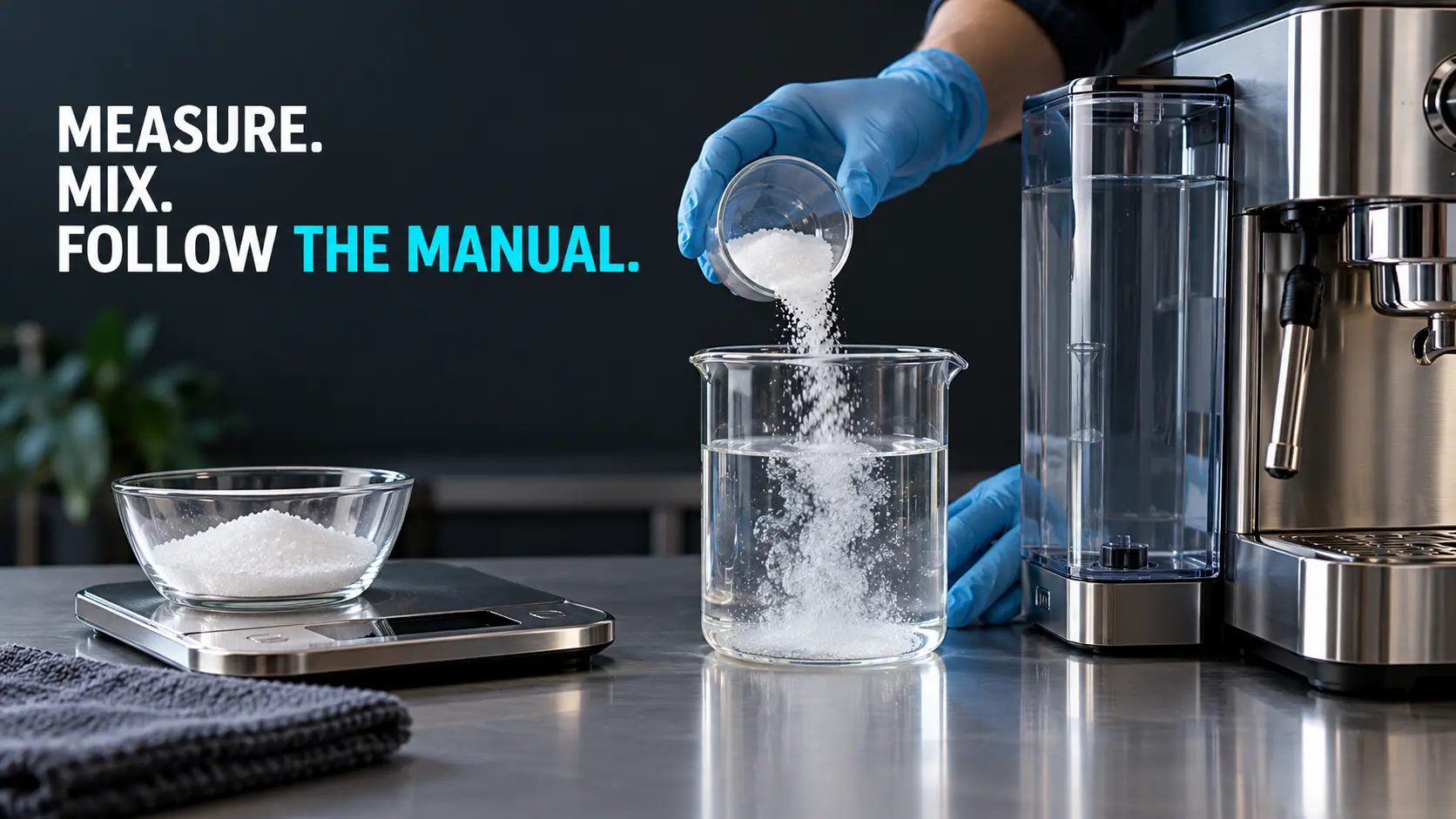
- Prepare only the instructed solution. If a product must be diluted, measure it exactly as stated. If the manual allows citric acid crystals, follow its specific concentration and mixing instructions; do not borrow a recipe from another model.
- Run the prescribed cycle. Select the machine’s descaling program if available. Place a sufficiently large container under the outlets and follow any prompts without interrupting the cycle.
- Complete every rinse. Discard the descaling liquid safely and refill the reservoir with clean water as instructed. Run the full rinse cycle or cycles; do not stop early because the liquid looks clear.
- Restore and verify. Reinstall or replace the water filter as specified, clean removable parts, and check that the machine dispenses normally without an acid taste or warning message.

Rinsing is part of the descaling process
Rinsing removes remaining descaler and dissolved material from the water path. A partial rinse can leave an unpleasant taste, cause irritation or interfere with the next drink. Follow the machine’s stated rinse volume or prompts, including any separate rinse for the reservoir, milk system or removable pieces. Never assume that one cup of water flushes every internal circuit.
After rinsing, dispense water into a waste container rather than straight into a drink. Check for foam, unusual odour, visible particles, persistent warning indicators or off-flavours. If any remain, repeat only the rinse step when the manual allows it; do not add more acid. If symptoms continue, stop using the machine and contact the manufacturer or an authorized service provider.
For a plumbed-in unit or commercial espresso machine, the rinse and return-to-service process may be more involved. The machine may have a boiler, group head, steam circuit and hot-water circuit with different paths. Use the service procedure, especially if the manufacturer calls for a technician. Consumer-appliance directions are not a substitute for a commercial maintenance plan.
How often should you descale?
Do not increase the frequency or acid strength just because one generic guide recommends it; use your machine’s own schedule.
Set the water-hardness setting correctly
There is no universal calendar interval. Follow the manual and alert system, and set water hardness using the manufacturer’s method. A filter may reduce mineral loading, but does not necessarily remove the need to descale; it also has its own replacement schedule.
Correct citric acid coffee machine descaling starts with the actual water and the machine’s maintenance setting, not an internet-wide calendar rule.
Keep a simple maintenance log
In a workplace or café, record the date, model, water source, filter status, alert, product and abnormal observations. If scale returns quickly, check the water and filter rather than increasing acid strength. Recurrence may signal a prevention or service issue.
Used correctly, citric acid coffee machine descaling is a model-specific maintenance task—not a blanket recommendation for every brand.
Citric acid, vinegar and commercial descaler
Citric acid and vinegar are both acidic but are not interchangeable machine-care products. Vinegar has a distinct lingering odour and is often discouraged. Some machines permit a citric-acid-based product; others specify a formulated blend. The label and manual—not a generic online claim—determine suitability.
| Option | Potential advantage | Main caution |
|---|---|---|
| Manufacturer-approved descaler | Designed for a named machine family and cycle | Use only as directed; do not substitute another formula casually |
| Citric-acid-based descaler | May be approved for particular models and can be dosed by label | Not approved for every appliance; confirm exact model guidance |
| Homemade citric acid | Ingredient is familiar and may be permitted by some manuals | Concentration and compatibility are easy to get wrong |
| Vinegar | Common household liquid | Often discouraged by manufacturers; odour and material risks |
Do not select a descaler based only on claims such as “natural,” “food safe” or “works on kettles.” Product grade and intended application matter. If you need supply specifications for professional formulation or procurement, the site’s industrial citric acid supply information is a starting point for sourcing questions, not an appliance-specific cleaning authorization.
Prevent scale instead of relying only on descaling
Use water that meets the appliance specification, keep the hardness setting correct, and replace filters on schedule. Empty or refill the reservoir as the manual recommends, and avoid leaving water stagnant for long periods. If your water is very hard, ask the manufacturer whether filtration or a specific water-treatment approach is compatible. Do not add softening agents, bottled water or mineral drops without checking the appliance guidance; some water compositions can affect sensors, taste or maintenance intervals.
After each use, follow the normal cleaning routine: empty grounds or capsules, rinse removable parts and clean milk-contact components with the designated method. These steps do not replace descaling but help separate mineral maintenance from coffee-oil and milk-soil cleaning. If you want to understand the deposit itself, read this explanation of calcium carbonate and its common applications.
For a wider discussion of citric acid’s handling and environmental context, see the site’s article on citric acid and environmental considerations. Product sourcing, cleaning efficacy and environmental claims are separate questions; assess them independently for the use case.
Common mistakes to avoid
- Using a recipe from another coffee-machine brand or model.
- Increasing the concentration because the first cycle did not clear an alert.
- Leaving acid in the reservoir or water path longer than directed.
- Skipping a rinse or assuming the machine’s first flush is enough.
- Mixing citric acid, vinegar, bleach, chlorine cleaner or detergent.
- Descaling repeatedly when the symptom may be a pump, filter or sensor fault.
- Ignoring a model-specific warning because a household remedy worked elsewhere.
Conclusion
Citric acid can dissolve scale, but the reaction is not the same as an appliance-approved procedure. Safe citric acid coffee machine descaling depends on the exact model, approved product, dose, cycle and complete rinse. Check the manual, avoid prohibited substitutions, and investigate recurring deposits through water hardness, filtration and service.
Frequently asked questions
1. Can I use citric acid to descale any coffee machine?
No. Some machine families allow or specify citric-acid-based descalers, while others discourage household citric acid. Check the manual for the exact model before use.
2. Is citric acid better than vinegar for coffee machines?
Neither is universally best. Some manufacturers reject both household remedies; some approve a citric-acid-based product for selected models. Use only the chemistry and process permitted by your appliance maker.
3. How much citric acid should I use?
There is no safe universal dose for every machine. Use only a dose stated by the model’s manual or by the approved descaler label. If no dose is specified, do not guess.
4. Can citric acid damage a coffee machine?
It can be unsuitable for certain materials, seals, finishes or machine designs, especially at the wrong concentration, temperature or contact time. Follow the manufacturer’s compatibility guidance.
5. How do I know descaling is complete?
Complete the full programmed descale and rinse sequence, confirm that alerts clear as instructed, and check for normal flow and taste. Persistent fault messages or unusual behaviour need service rather than extra acid.