


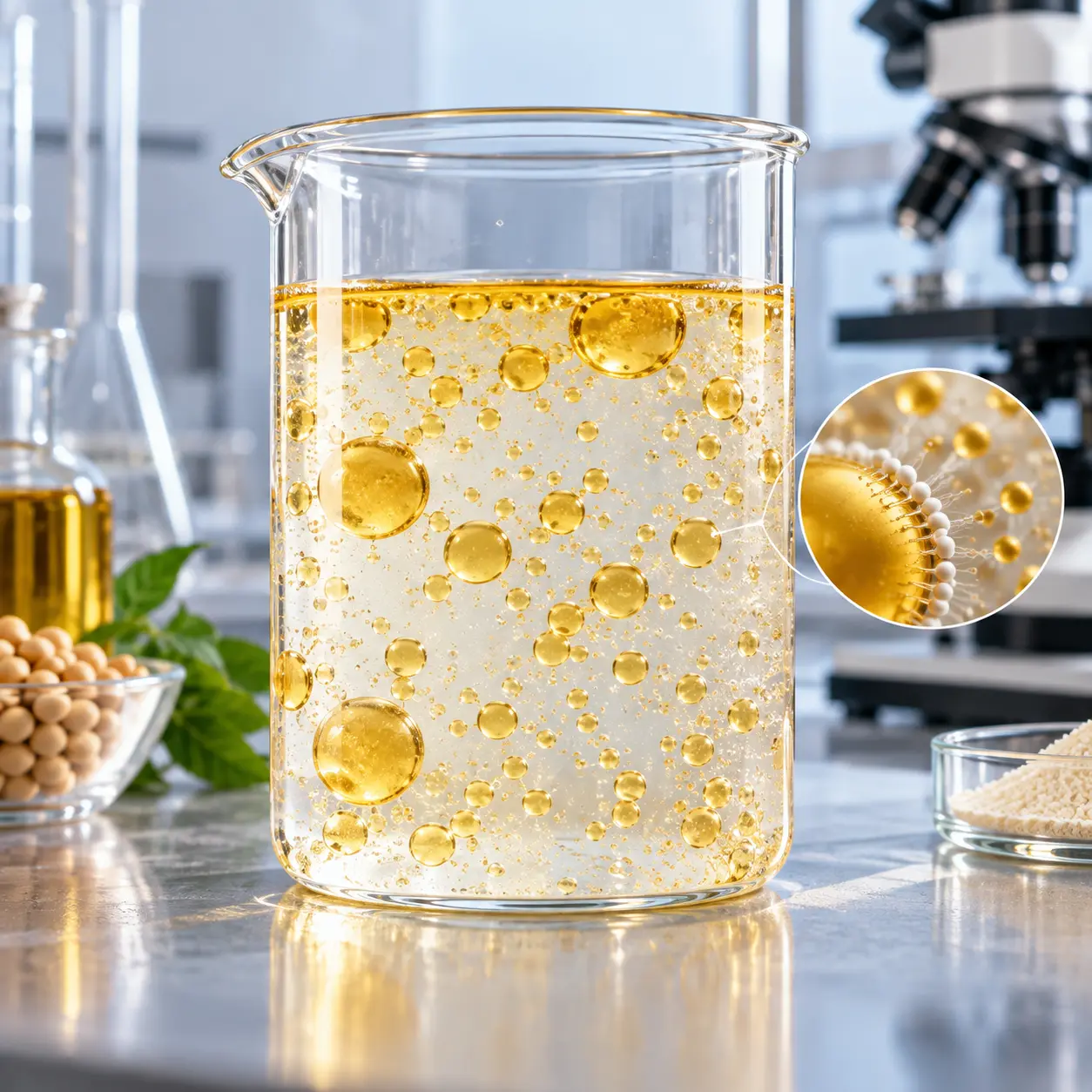
Food emulsifiers help oil and water stay evenly dispersed by creating a protective layer around droplets at the oil–water interface. In food manufacturing, the right emulsifier can support uniform texture, consistent appearance and reliable processing, but it must be evaluated in the actual formulation and used in line with the applicable food rules.
How food emulsifiers work is a core question in product development because oil and water naturally separate. Foods such as dressings, sauces, chocolate, bakery fillings and beverage systems often require these phases to remain controlled throughout production and storage. This article explains how food emulsifiers work, the factors that influence performance, and the practical checks manufacturers should make before scale-up.
What a food emulsifier does in a formulation
A food emulsifier has two compatible portions: one interacts more readily with water, while the other interacts more readily with oil. During mixing, it moves to the boundary between those phases and lowers interfacial tension. This makes it easier to create small droplets and makes those droplets less likely to join together again after processing.
The result is an emulsion: one liquid distributed as droplets through another liquid. In an oil-in-water emulsion, oil droplets are dispersed through water. In a water-in-oil emulsion, water droplets are dispersed through oil. The desired emulsion type should be established before choosing the emulsifier and process conditions.
Why simple mixing does not last
High-shear mixing can temporarily disperse oil in water without an emulsifier, yet that blend can quickly separate when agitation ends. Droplets move, collide and merge; cream rises or oil separates depending on density and the surrounding phase. An emulsifier does not remove every possible instability, but it can reduce coalescence and help preserve a controlled droplet distribution.
How food emulsifiers work at the oil-water interface
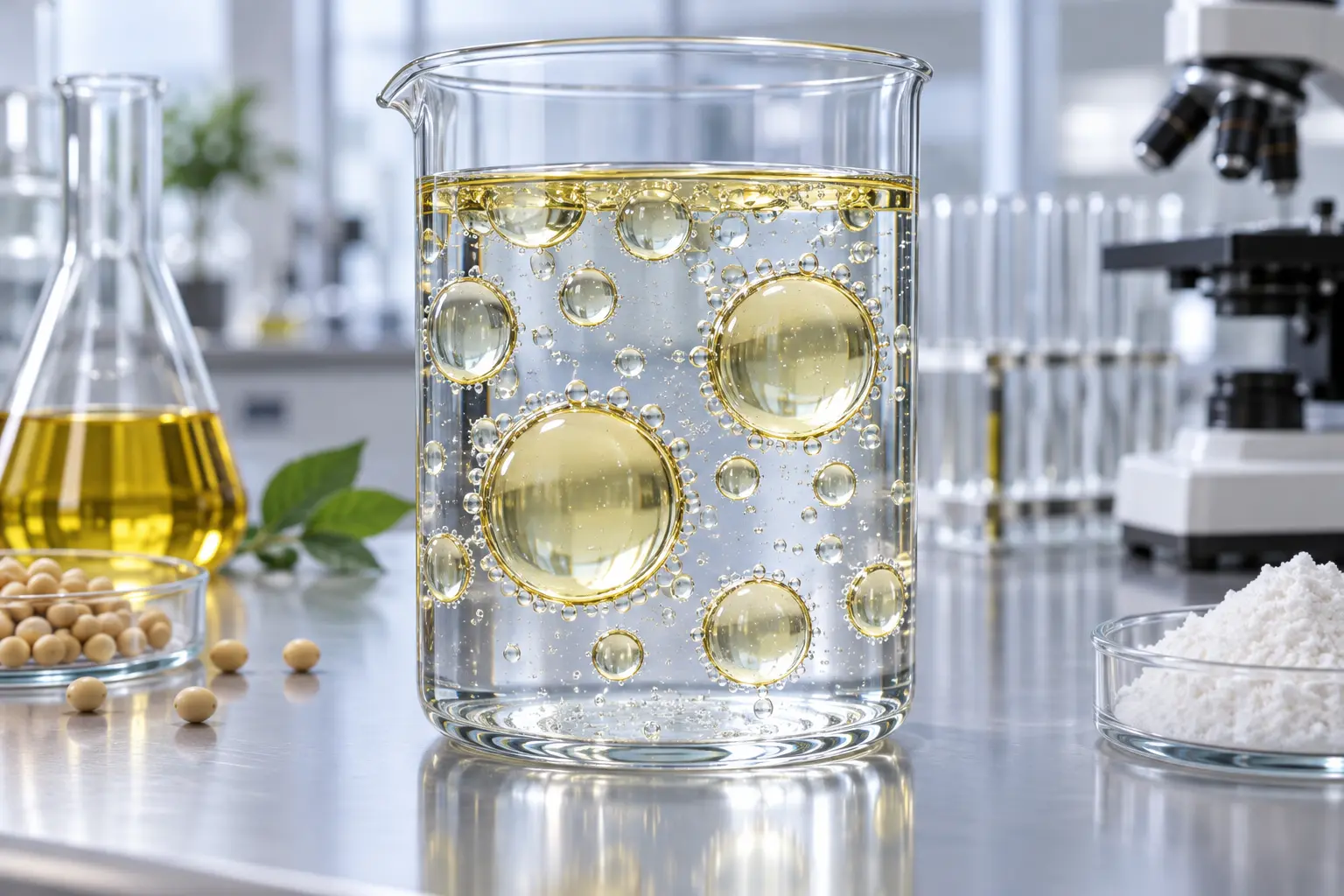
When oil is blended into water, an emulsifier can adsorb around the newly created droplets. Its oil-compatible portion faces the droplet, while its water-compatible portion faces the surrounding water phase. This arrangement creates an interfacial film that makes close contact and merging between droplets more difficult.
The exact mechanism depends on the emulsifier, the formula and the conditions. Some systems benefit from steric separation caused by a physical layer around droplets. Others also gain electrostatic repulsion where droplet surfaces have similar charge. Neither mechanism should be assumed in isolation: pH, salt content, proteins, sugars, fat composition and temperature can change the result.
Droplet size and mixing conditions
Homogenisation, mixing energy, temperature, viscosity and order of addition affect the final droplet size. Smaller, evenly distributed droplets can improve product stability, yet only if the emulsifier is able to cover the increased interface created by those droplets. A process that creates very small droplets without sufficient interface-active material can still produce instability later.
| Formulation factor | Why it matters | Practical check |
|---|---|---|
| Emulsion type | Determines the continuous phase | Confirm oil-in-water or water-in-oil target |
| pH and salts | Can change protein and droplet interactions | Test at the final product pH |
| Heat treatment | Can alter viscosity and ingredient behaviour | Use process-representative trials |
| Storage conditions | Reveal creaming and separation | Run a documented stability protocol |
Common food uses and functional outcomes
Food emulsifiers are used to create controlled texture, appearance and processing behaviour. In mayonnaise and dressings, they help maintain a dispersed oil phase. In bakery systems, emulsifier choice can influence dough handling, fat distribution and crumb properties. In chocolate and confectionery, the objective may be better particle wetting, viscosity management or flow rather than a typical oil-in-water emulsion.
Ingredient choice should reflect the exact required function, label strategy, manufacturing route and target-market compliance requirements. For an application-focused overview, see Silvari Group’s lecithin supply for European food manufacturers.
Why lecithin is widely used in food systems
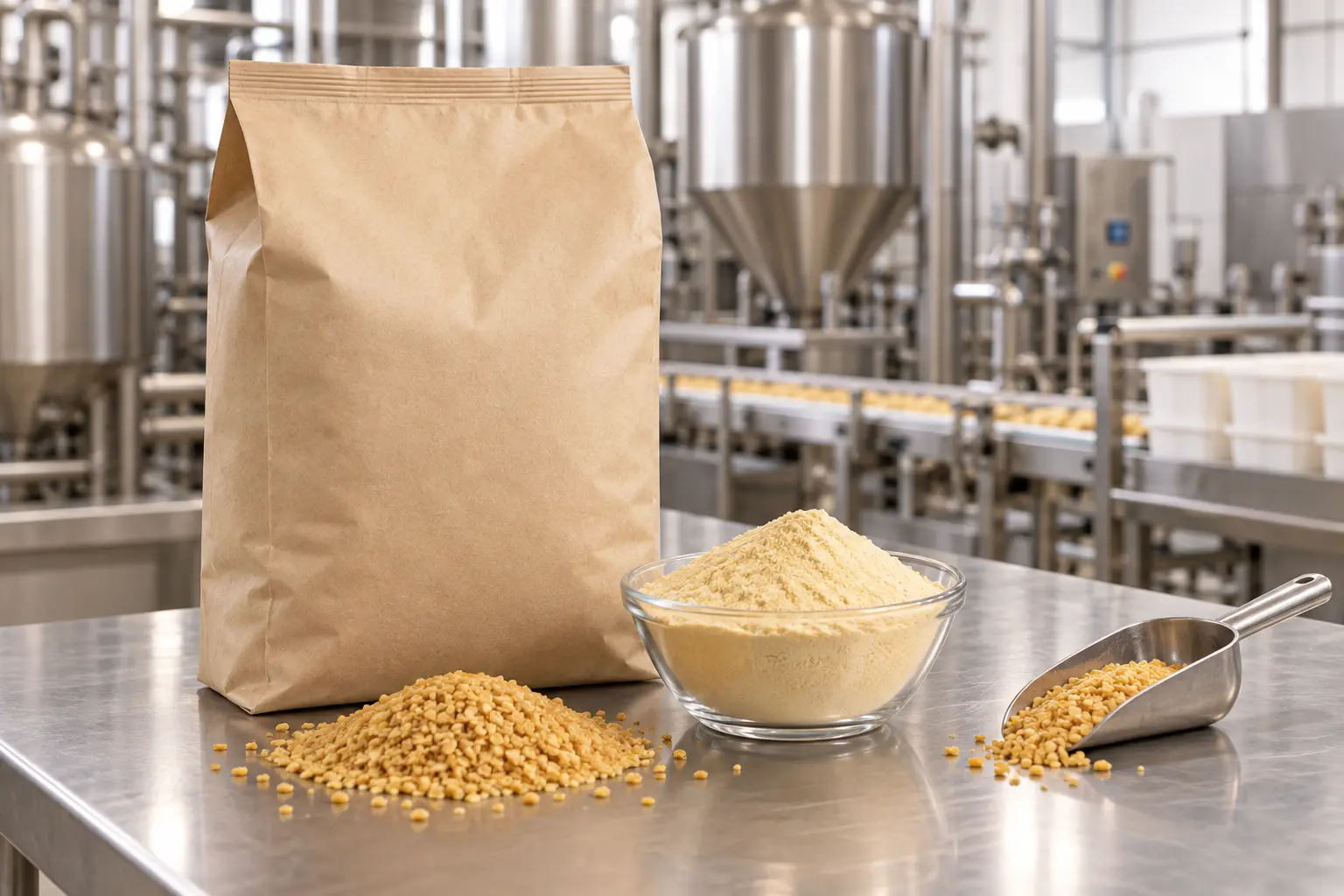
Lecithin is a mixture of phospholipids and related compounds commonly obtained from sources such as soy or sunflower. Its amphiphilic nature makes it useful in applications including chocolate, bakery, instant powders and selected emulsified foods. Depending on the formulation, it can support dispersion, help wet dry ingredients or contribute to viscosity control.
However, lecithin is not a universal answer to every separation issue. Source, grade, dosage, oil phase, water phase and the presence of proteins or hydrocolloids all influence its performance. A food manufacturer should assess the relevant specification, allergen information, storage recommendation and destination-market documentation before commercial use.
How formulators evaluate emulsifier performance
Effective evaluation begins with a defined problem. Is the failure visible oiling-off, creaming, sedimentation, poor reconstitution, inconsistent viscosity or an unacceptable mouthfeel? Each issue can have a different root cause, so a trial should compare a candidate emulsifier with a controlled baseline rather than changing multiple ingredients and process settings at the same time.
- Define the target: record the desired texture, appearance, shelf-life and processing behaviour.
- Control variables: compare dosage, mixing energy, temperature and addition order systematically.
- Test realistic conditions: include pH, heat treatment, packaging and expected storage conditions.
- Keep documentation: retain product specifications, process notes and food-safety records.
For a useful overview of ingredients intended for food use, read what food-grade chemical means in practice. A related explanation of food transformation is available in Silvari Group’s food chemistry guide.
Food emulsifier versus stabilizer in practice
Emulsifiers and stabilizers can work together, but the terms are not interchangeable. An emulsifier acts mainly at an interface and can assist formation and protection of droplets. A stabilizer may increase viscosity, bind water or form a network that slows droplet movement. A stable commercial formula may require both interface protection and bulk-phase structure.
For example, an emulsion may need an emulsifier to limit droplet coalescence and a hydrocolloid to reduce creaming during storage. Sensory performance still matters: too much viscosity can affect pourability, while an unsuitable emulsifier level can influence flavour release or mouthfeel. The goal is functional balance, not simply adding more ingredients.
Process variables that can change stability
Manufacturers should test a formulation under the same stresses it will experience in production and distribution. Heating can change viscosity, melt fat crystals or alter protein structure. Cooling may introduce crystallisation or phase changes. Freezing and thawing, pumping, filling operations and temperature cycling can expose instability that is not apparent in a freshly made laboratory sample.
Order of addition matters as well. Some emulsifiers are best hydrated in the water phase, while others are dispersed in oil or added at a defined temperature. Follow the technical guidance for the selected grade, then confirm the result with the actual raw materials and equipment used on the production line. A small-batch success does not automatically predict a large-scale result.

Food safety and regulatory considerations
Food ingredients must be assessed in the jurisdiction where the finished food is placed on the market. In the European Union, authorised food additives and their conditions of use follow the EU food-additives framework. In the United States, food additives and substances used in food are addressed through FDA requirements. Calling an ingredient food grade does not, by itself, confirm that it is permitted for every food category or use level.
Use the official European Commission food-additives guidance and FDA food-additives information when assessing the applicable market. Verify ingredient identity, purity criteria, permitted category, conditions of use and any maximum level before commercial manufacture.
Choosing the right emulsifier for a food product
Start with the food matrix rather than a generic list of ingredients. Identify the oil phase, water phase, processing temperature, shear conditions, shelf-life target, sensory expectations and label constraints. Candidate emulsifiers should then be tested in the actual formulation. A supplier discussion is more useful when it includes the intended food application, pH range, required certification and market destination.
For another food-emulsifier example, see Silvari Group’s technical discussion of Polysorbate 80 in food products. It illustrates a particular use case rather than a substitute for product-specific validation.
Conclusion: stable food emulsions need whole-system testing
How food emulsifiers work comes down to controlled interactions at the oil–water interface. They can support stable, appealing and processable products, but performance depends on ingredients, processing and storage conditions working together. Select an ingredient on evidence from representative trials, then verify food-safety compliance for the target market before scale-up.
Frequently Asked Questions
1. What is the main purpose of a food emulsifier?
Its main purpose is to help phases that normally separate, especially oil and water, remain dispersed in a controlled food system.
2. Are all emulsifiers suitable for every food?
No. Suitability depends on the product type, process, required function, ingredient specification and legal conditions of use.
3. Does an emulsifier replace proper mixing?
No. Mixing and homogenisation create droplets; the emulsifier helps manage the interface and improve stability after processing.
4. Can a stabilizer replace an emulsifier?
Not always. Stabilizers can support the bulk structure, while emulsifiers primarily act at interfaces. Some formulas need both.
5. What should a manufacturer verify before use?
Verify identity, specification, allergen status, permitted use, dosage, processing performance and supporting documentation for the target market.
Talk to a food-ingredient specialist
If you are evaluating lecithin or another emulsifier for a commercial formulation, prepare the application details and compliance requirements before consulting a qualified ingredient supplier. This supports a focused technical review and more appropriate product selection.